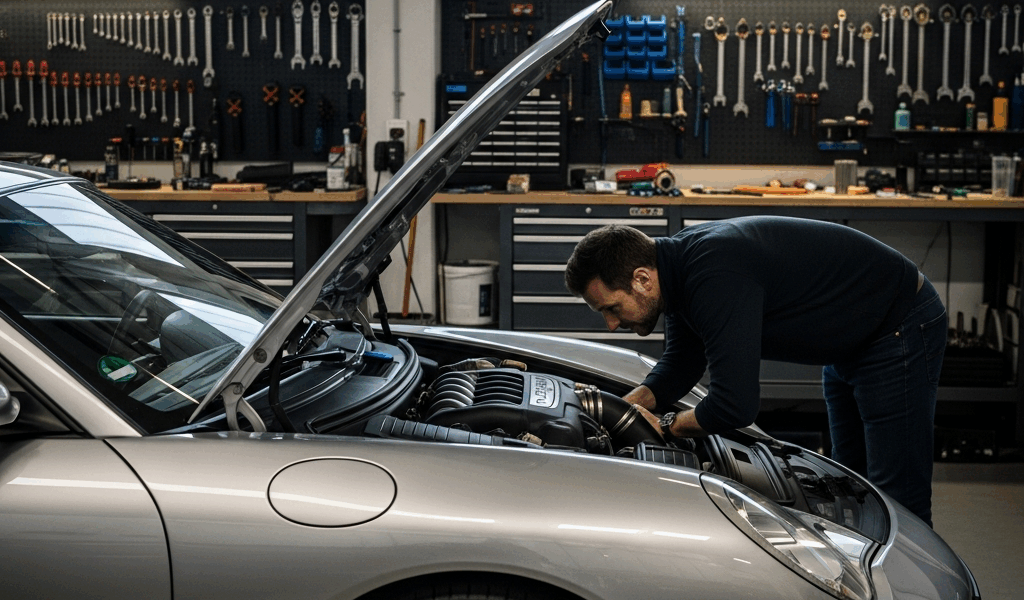
You’re looking at a Porsche 996 — a real 911, flat-six, rear-engine — for a fraction of what a 997 costs. The price seems too good. Then someone mentions the IMS bearing, and suddenly you’re reading horror stories about catastrophic engine failures and five-figure repair bills. Here’s what the IMS bearing situation actually looks like in 2026, what it costs to fix, and whether a 996 is still worth buying.
What Is the IMS Bearing and Why Does It Fail?
The Intermediate Shaft Bearing (IMS) sits at the flywheel end of the intermediate shaft inside the M96 and M97 flat-six engines used in the 996 (1997-2004) and early 997 (2005-2008). The intermediate shaft drives the camshafts via chains, and the bearing supports the shaft where it exits the engine case.
The design problem: Porsche used a sealed ball bearing in this location. Sealed means it arrived from the factory with a fixed amount of grease inside and was never intended to receive lubrication from the engine’s oil system. Over years of use and thousands of heat cycles, that factory grease degrades. The seal eventually fails, what’s left of the grease washes out, and the bearing runs dry. A dry bearing seizes. When the IMS bearing seizes, it takes the intermediate shaft with it, which destroys the engine’s timing, bends valves, and can crack the engine case. Total engine failure. Repair cost: $15,000 to $25,000 for an engine rebuild or replacement.
The estimated failure rate is debated — somewhere between 1% and 8% depending on the model year, maintenance history, and who you ask. But even at 1%, the consequence is so severe that the IMS bearing dominates every 996 purchase conversation.
Which 996 Years Are Most at Risk?
1997-2001 (single-row IMS bearing): Highest failure risk. These early M96 engines used a smaller, single-row ball bearing with less load capacity. This is the group responsible for most of the horror stories.
2002-2005 (double-row IMS bearing): Lower failure rate. Porsche switched to a larger double-row bearing that handles the load better, but the fundamental design flaw — sealed bearing, no external lubrication — remains. The risk is reduced, not eliminated.
2006+ (997.1): Redesigned bearing with significantly lower failure rate. Still technically present in the M97 engine, but failures are rare enough that most 997 buyers don’t lose sleep over it.
The bottom line: any pre-2002 996 that has not had the IMS retrofit should be treated as a ticking clock. The question isn’t if the bearing will fail, but whether it will fail before you fix it.
The IMS Retrofit — Cost and Timing
The IMS Solution, developed by Flat 6 Innovations (formerly LN Engineering), replaces the sealed factory bearing with an open-race bearing that receives proper lubrication from the engine’s oil circuit. This eliminates the failure mode entirely. The sealed bearing that dries out and seizes is replaced by a bearing that is continuously lubricated for the life of the engine.
Cost: $2,000 to $4,000 installed, depending on the shop and whether additional work is done at the same time.
The smart timing: During a clutch replacement. The engine and transmission must be separated to access the IMS bearing, and they must also be separated to replace the clutch. Combining the two jobs saves $1,500 or more in labor because you’re not paying to drop the engine twice. Most 996 clutches need replacement between 60,000 and 90,000 miles — if the car is approaching that window, do both at once.
A 996 with a documented IMS retrofit and fresh clutch commands a $2,000 to $4,000 premium on the market — and rightfully so. The buyer is paying for work already done and risk already eliminated.
Is a 996 Still Worth It After Factoring in the IMS?
Yes — if you price it correctly. A 996 with documented IMS retrofit and clutch replacement runs $25,000 to $40,000 depending on year, spec, and mileage. That’s a genuine Porsche 911 — flat-six, rear-engine, the real driving experience — for roughly half the cost of a comparable 997.
If the IMS work hasn’t been done, budget $3,000 to $5,000 for the retrofit immediately after purchase. A $20,000 996 without IMS work is really a $25,000 car once you eliminate the risk. Sellers who haven’t done the retrofit know this, and the market prices it in — but not always accurately. Educated buyers negotiate accordingly.
The cars to be cautious about: 1997-2001 models with high mileage and no documented IMS work. Every additional mile on the original sealed bearing is another mile closer to potential failure. The bearing doesn’t give warning signs — when it goes, it goes. For pre-2002 cars, the IMS retrofit isn’t optional maintenance. It’s the price of admission.
Pre-Purchase Inspection Checklist for 996 Buyers
IMS retrofit documentation: Look for an invoice from a reputable Porsche independent shop naming the specific parts used (Flat 6 Innovations or LN Engineering IMS Solution). Verbal claims don’t count — you need paper.
Clutch replacement history: Tells you when the IMS was last accessible and whether the work was combined (the smart approach).
Oil consumption: More than 1 quart per 1,000 miles indicates cylinder liner issues (the D-chunk problem) or piston ring wear. Some consumption is normal on M96 engines, but excessive consumption signals deeper problems.
Coolant system: The M96 uses plastic coolant pipes that deteriorate with age. Check for leaks around the pipe connections. If the plastic pipes haven’t been replaced with aluminum upgrades, budget $500-800 for that job.
Rear Main Seal (RMS) leak: Common on M96 engines, usually visible as oil weeping from the engine-transmission junction. It’s a nuisance, not a catastrophe — budget $1,200-$1,800 for the repair if present, but don’t walk away from an otherwise good car because of it.
A pre-purchase inspection by an experienced Porsche independent shop ($200-400) is the best money you’ll spend on a 996 purchase. They know exactly where to look and what the M96 engine’s weak points feel like at different mileage ranges.



Stay in the loop
Get the latest classic car craze updates delivered to your inbox.