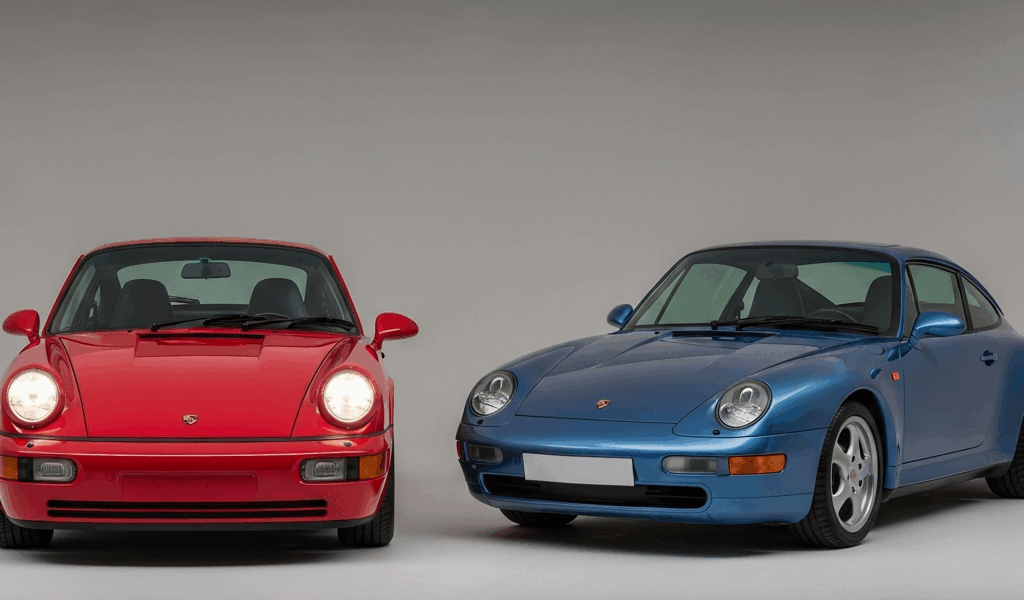
Porsche 964 vs 993 — Which Air-Cooled 911 Should You Buy?
The Porsche 964 vs 993 debate has gotten complicated with all the forum noise, parking lot pontificating, and PCA chapter strong opinions flying around. As someone who’s owned a 1991 964 Carrera 2 for six years — and spent serious time in friends’ 993s, including a 1997 Carrera S that made me question every automotive decision I’ve ever made — I learned everything there is to know about what actually separates these two cars. Both are genuinely great. But they are not the same car. Which one you should buy depends almost entirely on what you actually want from a 911.
Short version: the 964 feels older. The 993 feels like a proper modern sports car. Neither of those is a criticism. One is a feature.
The Driving Experience — Raw vs Refined
A group of Porsche friends with more diverse garages than mine corralled me into a weekend run up Angeles Crest Highway — the kind of Saturday morning where nobody announces a meetup but somehow eight cars show up anyway. When I swapped into a colleague’s 993 Carrera for a stretch, something clicked immediately. The effort required to drive it well is just lower. Not boring-lower. Composed-lower. The kind of composed that lets you think about corner entry instead of managing the car’s mood.
The 964 asks more of you. Its power steering is lighter in terms of assistance — which sounds backwards, I know — but what that means in practice is more physical input required, more feedback delivered in return. You feel the road texture. The tire loading. The weight transfer happening beneath you. At parking lot speeds it’s heavier to operate. On a mountain road it becomes information. Whether that’s a good thing depends entirely on your relationship with driving as a physical act versus driving as an experience you observe from the seat.
Suspension — The Multilink Changes Everything
The single biggest engineering difference between these two cars is the rear suspension — and it’s not subtle. The 964 runs a semi-trailing arm setup Porsche had been refining since the late 1960s. It works. It’s not bad. But there’s a fundamental geometric limitation baked in: under cornering loads, the rear can step out with less warning than you’d prefer, especially in the wet. That’s the characteristic that gave air-cooled 911s their spicy reputation in the first place.
The 993 introduced Porsche’s LSA multilink rear suspension. Five links per side. The geometry stays consistent through suspension travel instead of changing — which means the rear end behaves predictably. Not boringly predictably. Better predictably. The 993 can absolutely be driven aggressively and will reward commitment. It just won’t punish a lapse in concentration the way a 964 can on a cold, damp road.
Don’t make my mistake. On a damp morning run near my house — nothing heroic, a road I’d driven a hundred times — I got slightly aggressive with the throttle exiting a long left-hander. The 964’s rear moved. Not dramatically, I caught it, but it moved in a way that reminded me these cars predate stability control and they remember that. A 993 in that same corner would have simply gone around it.
The Engine Character
Both cars run air-cooled flat-six engines from the same lineage. The 964 Carrera 2 makes 247 horsepower from its 3.6-liter M64. The base 993 Carrera bumps that to 272 horsepower from a revised 3.6-liter, with the Carrera S at 285 hp. But the numbers aren’t what tells the story.
The 993 VarioRam system — introduced in 1996 — uses variable-length intake runners to improve mid-range torque significantly. Below 5,000 RPM, the 993 feels substantially more tractable than the 964. Above 5,000 RPM, both engines scream in the same glorious, mechanical way that no water-cooled engine has ever quite replicated. The VarioRam is a big reason the 993 works better as a daily driver. It’s also one more thing that can fail — worth keeping in mind.
Ride quality is noticeably different too. The 993’s more sophisticated suspension absorbs road imperfections better. The 964, particularly on original-spec suspension, transmits more to the driver. Whether that’s road feedback or road harshness honestly depends on your mood that day.
Current Market Values
Probably should have opened with this section, honestly — because for most buyers the price difference forces the decision before driving preference even enters the conversation.
As of 2024, a solid driver-quality 964 Carrera 2 in Guards Red or Grand Prix White — the more common colors — sits somewhere between $65,000 and $85,000. A well-documented, single-owner example in something like Slate Blue or Speed Yellow, with Porsche Certificate of Authenticity paperwork, can push $95,000 to $105,000. Turbos and RS variants are a completely different conversation — they start around $200,000 for anything presentable.
The 993 starts higher. A comparable driver-quality 993 Carrera 2 runs $80,000 to $110,000. Later model years — 1997 and 1998 specifically — command a premium because of the VarioRam engine and because buyers perceive them as the most refined air-cooled 911 Porsche ever made. A clean, low-mileage 1997 Carrera S in a good color will hit $125,000 to $140,000 without much effort. The 993 Turbo starts at $175,000 — and the Turbo S, if you find one, is well north of $400,000.
Appreciation Trajectory
Here’s where the 964 makes a compelling financial case alongside its driving case. From 2018 to 2024, well-documented 964 Carreras have appreciated roughly 60 to 80 percent. The 993 has also appreciated, but from a higher starting base — and percentage gains on standard Carrera variants have been slightly more modest. The theory, which I think is correct, is that the 964 was genuinely undervalued for years because buyers simply preferred the more refined 993. That gap has narrowed considerably.
Neither car should be bought purely as an investment. Buy one because you want to drive it. But if you’re choosing between two cars at a similar total budget, the 964 offers slightly more room for appreciation from where prices sit right now.
Condition Over Model
A $75,000 964 with a comprehensive service history, original paint, and a Pre-Purchase Inspection from a qualified Porsche independent — a shop with actual PIWIS diagnostic capability, not a general mechanic who’s “worked on Porsches” — will hold its value and give you far less trouble than an $85,000 example with records gaps and an undisclosed repaint. Same logic applies absolutely to the 993. Condition and documentation matter more than the model designation. Every single time, without exception.
Maintenance and Ownership Reality
Air-cooled 911 ownership carries a reputation for expense that’s partially deserved and partially mythology. Let me separate those two things.
The fundamental engine architecture of both cars is robust. A properly maintained 964 or 993 engine — regular oil changes, I run Mobil 1 15W-50 though the Porsche community will debate this endlessly over cold brew at any cars-and-coffee — can run well past 150,000 miles without major internal work. The engines aren’t fragile. What they are is unforgiving of neglect. There’s a meaningful difference there.
The 964-Specific Items
The 964 has a few well-documented maintenance concerns worth knowing upfront. The IMS bearing issue that plagued early water-cooled cars doesn’t apply here — that’s a common misconception. What does apply: engine case studs can work loose over time, which becomes a significant repair if ignored too long. Chain tensioners should be inspected. The Carrera 2’s Bosch Motronic 2.1 engine management system is simpler than the 993’s electronics — fewer potential failure points, easier diagnosis with older equipment. That simplicity is genuinely appealing.
Budget roughly $3,000 to $5,000 annually for maintenance on a well-maintained 964 if you’re driving it 5,000 to 8,000 miles per year. Major services — valve adjustments, spark plugs, air and oil filters, brake fluid flush — run about $1,200 to $1,800 at a reputable independent shop. Dealer pricing typically runs 30 to 40 percent higher for identical work.
The 993-Specific Items
The 993 shares most of the same fundamental maintenance items. Annual costs are comparable — budget similarly, perhaps $3,500 to $5,500 depending on mileage and what the previous owner quietly deferred.
The VarioRam intake system adds a genuine maintenance consideration. Actuators and linkage controlling the variable runners can fail — typically showing up as a rough idle or the disappearance of that mid-range torque the system exists to provide. A VarioRam rebuild or repair runs $800 to $2,500 depending on exactly what’s failed and who does the work. It’s not catastrophic. But it’s a system the 964 doesn’t have, which means it’s a failure mode the 964 doesn’t have either. That’s what makes the 964’s simplicity endearing to us purists.
The 993’s more complex electronics — Bosch Motronic 5.2, updated to 7.8 on 1997-1998 cars — require a shop with proper diagnostic capability. Most established Porsche independents have this covered. A shop that grew up on 993s will find it straightforward. An unfamiliar shop can struggle in ways that cost you money and time.
Sourcing Parts
Parts availability for both cars is excellent by classic car standards. Pelican Parts, Stoddard Porsche, and ISN carry extensive inventories — you won’t be hunting obscure suppliers for most jobs. Genuine Porsche dealer parts are available for most items on both cars. A handful of trim pieces and rubber seals have become harder to source for the 964, simply because of age. The 993, being seven or eight years newer depending on model year, has slightly better parts availability across the board. Not dramatically different — both cars are well-supported — but it’s a real difference on specific items, and you’ll notice it eventually.
The Verdict
Buy the best example you can afford. That’s the starting point for any air-cooled 911 purchase — it matters more than the 964 vs 993 question itself. A mediocre 993 is worse than an excellent 964 in every meaningful way: financially, mechanically, experientially. Get a Pre-Purchase Inspection from a specialist who actually knows these cars. Budget $400 to $600 for it. Treat any seller who won’t submit to an independent PPI as a hard pass — because they are.
With that said — if you’re forcing me to choose, here’s where I actually land after six years of 964 ownership and honest time in 993s.
Choose the 964 if:
- You want the most visceral, communicative driving experience of the two
- You plan to drive on weekends and occasional road trips rather than daily
- You prefer simpler electronics and a more mechanical ownership experience
- Your budget is genuinely in the $65,000 to $90,000 range and you don’t want to stretch
- The classic 911 aesthetic — the slightly rawer, older feel — appeals to you philosophically
Choose the 993 if:
- You want to drive the car more frequently, including in variable weather conditions
- The multilink rear suspension’s improved stability matters to you — and if you’re being honest about your skill level, it probably should
- You want the best air-cooled 911 Porsche ever built in terms of outright engineering
- Mid-range torque and daily usability are genuine priorities, not just nice-to-haves
- Budget is flexible enough to absorb the $15,000 to $25,000 premium over a comparable 964
The 993 might be the better car by most objective measures — faster, more stable, more comfortable, more tractable — as driving a sports car daily requires a level of refinement the 964 simply wasn’t built to provide. That is because Porsche designed a decade of genuine engineering progress into the 993’s architecture. The 964, though, is the more involving car by the measures that matter when you’re alone on a good road on a Sunday morning. Those are genuinely different things, and reasonable people prioritize them differently.
I’ve kept my 964. Haven’t regretted it for a single day. But I’ve also never pretended it’s the sensible choice — it’s just the right choice for how I use it and what I want from it. Figure out your version of that question first, and the 964 vs 993 answer will arrive on its own.


Stay in the loop
Get the latest classic car craze updates delivered to your inbox.