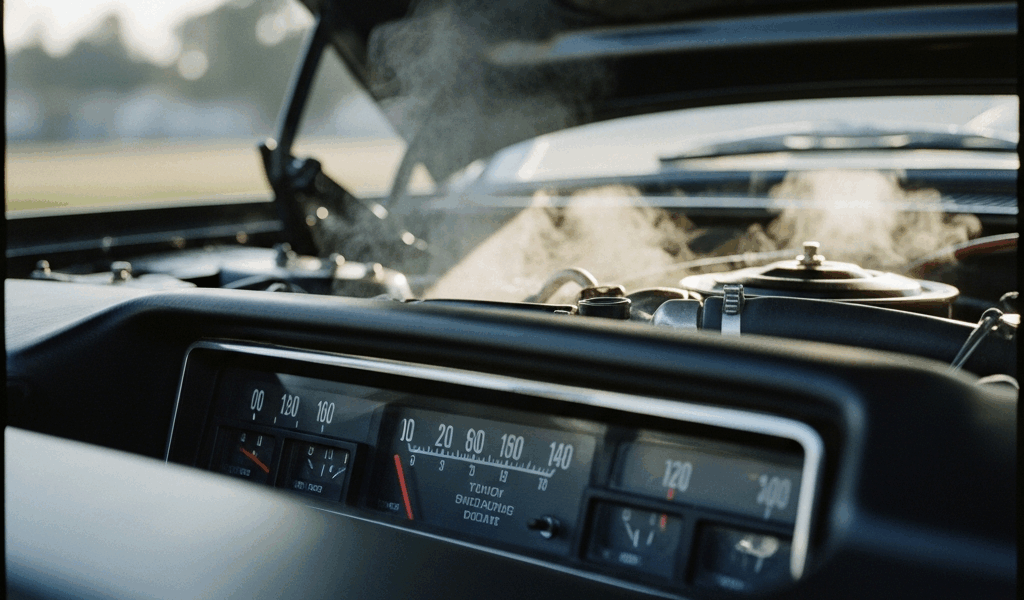
Why Overheating at Idle Is a Different Problem
Classic car overheating has gotten complicated with all the conflicting advice flying around. As someone who spent an ugly afternoon in a parking lot watching a 1972 Chevelle climb past 220 degrees the moment traffic stopped, I learned everything there is to know about idle-specific overheating. Today, I will share it all with you.
The physics here are brutal. At idle, your engine produces full heat — but the cooling system fights with both hands tied behind its back. Coolant circulates slowly at low RPM. The fan works hardest precisely when the car isn’t moving, yet ambient airflow through the radiator drops to zero. A highway cruise gives you ram air assistance plus higher water pump speed working together. A parking lot gives you nothing. You’re asking the system to shed full engine heat with almost no help.
That distinction matters more than most people realize. A car that overheats only while idling points to a specific cluster of failures — fan problems, a sticking thermostat, radiator blockage, low coolant. Highway overheating usually signals something different entirely, like a worn water pump or a slow leak. If your temperature gauge climbs the moment you stop at a red light but settles once you’re moving again, keep reading. You’re dealing with an idle-specific diagnosis, and the fix is probably simpler than you think.
Check the Cooling Fan First
The cooling fan is your first suspect. Period. I’d stake money on it.
Start with the fan clutch if you’re running a mechanical fan — the belt-driven kind. A slipping clutch won’t engage fully as coolant temperature climbs. You’ll see the fan spinning lazily instead of roaring the way it should. Bent or damaged blades tell a similar story. They move air, just not efficiently. Depending on whether you’re replacing just the clutch or the whole assembly, expect to spend somewhere between $40 and $200.
Electric fans are a different animal entirely. Many classic car restorations involve swapping to electric for reliability and simplicity. I’ve done three of these swaps myself — on a ’69 Camaro, a ’71 Nova, and a ’74 Duster — and every single one had wiring gremlins at first. The fan relies on a relay, a temperature sensor, and clean connections. Any weak link breaks the whole chain.
The Driveway Fan Test
Here’s what I do before spending a dime: start the engine cold and let it warm to operating temperature. Watch the fan. A mechanical fan clutch should engage noticeably around 180 to 190 degrees — you’ll hear it roar. An electric fan should kick on around 190 to 200 degrees. If neither happens, or the fan just spins lazily, you’ve found your culprit.
For electric fans, grab a multimeter and test the relay. Most automotive relays run $15 to $30. A bad one kills the whole system. Check for 12 volts at the relay input when the engine’s hot. No voltage? The temperature sensor is bad or the wiring’s corroded somewhere. Voltage present but the fan still won’t spin? The relay or the fan motor itself has failed.
Replace the fan or relay, and nine times out of ten, your idle overheating vanishes. That’s what makes this diagnostic step so endearing to us classic car people — it’s cheap, it’s fast, and it usually wins.
Thermostat and Coolant Flow Problems
Probably should have opened with this section, honestly. A stuck thermostat is the second most common culprit, and it’s sneaky because it hits idle harder than highway driving.
But what is a thermostat, exactly? In essence, it’s a spring-loaded valve that opens at a specific temperature to let coolant circulate through the radiator. But it’s much more than that — it’s the gatekeeper for your entire cooling cycle. Most classics run either a 180-degree or 195-degree unit. A stuck thermostat — one that won’t open fully — restricts flow and causes heat buildup fast. At idle, with minimal coolant movement anyway, a partially stuck thermostat becomes catastrophic in a hurry.
The wrong thermostat temperature causes its own problems. I once inherited a ’68 Coronet with a 160-degree stat already installed. The previous owner figured lower temperature meant cooler running. Don’t make my mistake of assuming the same thing. A thermostat that opens too early means the engine never reaches proper operating temperature — it runs richer, fouls plugs, and still overheats at idle because the cold-start enrichment logic never fully shuts off.
Testing Your Thermostat at Home
Pull the thermostat from the housing. Fill a pot with water and drop in a thermometer. Heat the water slowly and drop the thermostat in. Watch it. A 195-degree stat should begin opening around 185 to 190 degrees and be fully open by 205 degrees. No movement means it’s stuck. Opens early or stays sluggish? Replace it.
Cost: $12 to $35 for the part, maybe 30 minutes of your time if you’re reasonably handy with a wrench.
Water pump wear deserves a mention here too. A weak or worn pump simply can’t circulate coolant fast enough at low RPM — and this shows up almost exclusively as idle overheating, since highway speeds give the pump enough mechanical advantage to compensate. Inspect your pump for weeping around the weep hole, which is that small drain port on the bottom of the housing. Seepage there means the bearings are going and replacement is due. A quality unit from Gates or Airtex runs $60 to $150 depending on the application.
Radiator Issues That Show Up at Idle
A clogged radiator is deceptive. Your car drives fine at 55 mph on the highway. The moment you park and it idles hot? Internal blockage emerges as the likely culprit.
Rust deposits, mineral buildup from degraded coolant, sludge — these accumulate slowly over years and decades. A car that’s been sitting since the mid-1990s and still has its original coolant is a prime candidate. I’m apparently sensitive to this one — I’ve pulled three radiators in the last two years that looked fine externally and were nearly solid inside. The blockage restricts flow enough that slow idle circulation can’t shed heat, but highway ram air pressure and higher coolant velocity sometimes push enough flow through to keep temperatures barely manageable.
A simple test: drain your cooling system and capture the fluid properly. Insert a garden hose into the top radiator inlet and flush water through for two minutes. Watch the outlet. If water trickles instead of flows freely, you have internal blockage. A radiator shop can hot-tank and rod it out for around $100 to $200 — usually cheaper than a new unit if the core is otherwise solid.
Other Radiator Culprits
Low coolant level is obvious but worth stating plainly. Check your system cold, first thing in the morning before the engine starts. The coolant should sit at the “full” line on the overflow tank — not close to it, at it. Low coolant reduces heat rejection capacity fast. Top it up with a 50/50 mix of distilled water and Dex-Cool or green conventional coolant, whichever your system runs. If you’re losing coolant regularly, you have a leak somewhere — hose, fitting, or water pump seal — that needs its own diagnosis.
A weak radiator pressure cap surprises people. The cap maintains system pressure, which raises the boiling point of your coolant. A cap that won’t hold pressure — typically 13 to 16 PSI for most classics — allows coolant to boil at a lower temperature, which reduces cooling capacity and accelerates idle overheating.
Test this: buy a radiator pressure tester at AutoZone or O’Reilly for around $25. Pressurize your system to 15 PSI with the engine cold. The gauge should hold steady for a full minute. If it drops, the cap is bad or the system has a leak. Replace the cap first — $10 to $20 — before suspecting anything worse. So, without further ado, move down this list in order before you start pulling major components.
When to Suspect a Head Gasket or Worse
Stop here if you see any of these warning signs. They mean your problem is bigger than a fan relay.
Bubbles rising in your overflow tank while the engine idles — that’s combustion gases entering the cooling system. Blown head gasket. White exhaust smoke at idle, especially if it smells faintly sweet like coolant, confirms it. Milky, tan-colored oil on your dipstick is the final nail: coolant has mixed with engine oil, and lubrication is already compromised.
These symptoms demand a block test before you chase thermostats and radiators. A mechanic performs this by inserting a chemical test strip — usually a blue combustion leak detector fluid — into the radiator neck. Combustion gases present? The fluid changes color from blue to yellow. Cost runs about $75 to $150 at most independent shops. That test saves you real money, because a head gasket replacement on a big-block — $800 to $2,000 depending on the engine — is worlds different from a $15 thermostat swap.
A cracked cylinder head or block is rare but possible, especially in older iron-block engines that took freeze damage at some point. Symptoms are identical to head gasket failure. The block test reveals this too.
I’m apparently stubborn enough to have ignored milky oil once on a small-block 350. Don’t make my mistake. If you see bubbles, white smoke, or that telltale tan sludge on the dipstick, stop driving immediately. Let the engine cool completely, do the block test, and go from there. Running an engine with a blown gasket accelerates internal damage fast — warped heads, scored cylinder walls, the whole nightmare.
For everyone without those warning signs, work through the diagnostics in order: fan first, thermostat second, radiator third, coolant level fourth, pressure cap fifth. Most idle overheating resolves within the first two steps. Be methodical, test before replacing anything, and your classic will stay cool in traffic where it matters most.


Stay in the loop
Get the latest classic car craze updates delivered to your inbox.