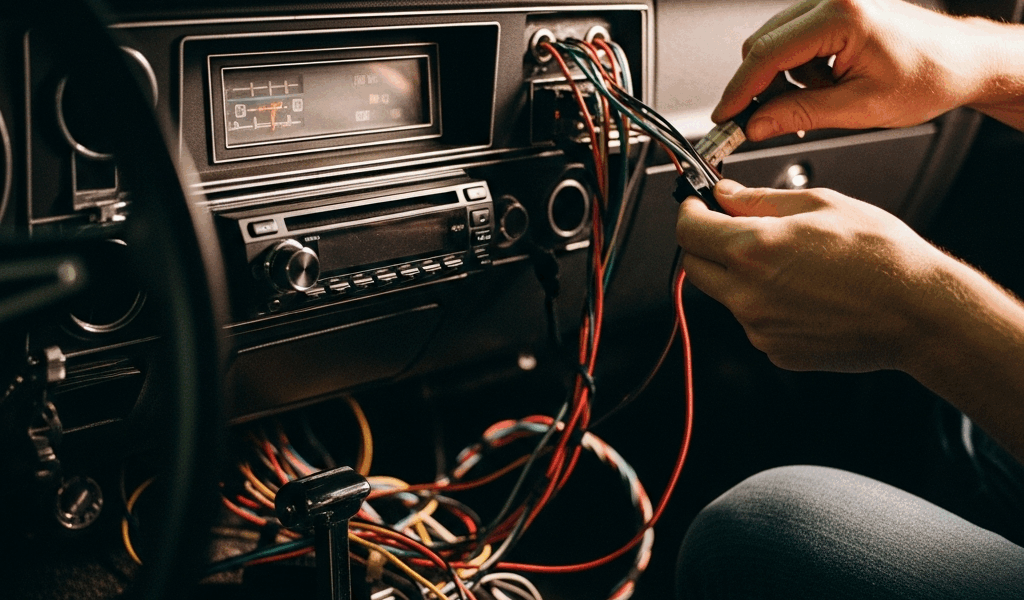
You turn up the volume and there it is — a whining buzz that climbs in pitch every time you hit the gas. Your car radio was fine at idle, and now it sounds like it’s possessed. That noise is almost always electrical interference getting into your audio system, and it has three common causes in classic cars. The fix depends on which one you’ve got.
Is It Alternator Whine or a Ground Loop?
These two problems sound different, and that difference tells you exactly where to start.
Alternator whine changes pitch with engine RPM. Rev the engine and the pitch rises. Let it idle and the pitch drops. The sound follows the tachometer because the alternator’s electrical output is bleeding into the audio signal path. This is the most common cause of radio buzz in classic cars with aftermarket head units.
Ground loop buzz stays constant regardless of RPM. It’s a steady hum or buzz that doesn’t change when you accelerate. Ground loops happen when your audio equipment has multiple ground points at different electrical potentials on the chassis.
Quick diagnostic: turn the key to the accessory position (engine off, radio on). If the buzz disappears, it’s RPM-related — alternator whine or ignition interference. If the buzz is still there with the engine off, it’s a grounding issue.
Fix 1 — Alternator Whine
An inline noise filter on the power wire to the head unit solves most alternator whine. These run $10 to $20 and install in minutes — wire it into the 12V power lead going to the back of your stereo. The filter blocks the high-frequency noise from the alternator’s charging circuit before it reaches the audio system.
But before you buy a filter, check the head unit’s ground wire. A poor ground is the number one cause of alternator whine in classic cars, and it costs nothing to fix. The ground wire from the back of your stereo should connect to bare metal on the chassis — scraped clean, no paint, no rust, tight connection. In a 40-year-old car, that ground point has probably corroded. Scrape it clean, reconnect, and test. You might not need the filter at all.
For cars running a generator instead of an alternator (pre-1960s vehicles), a capacitor wired across the generator’s output terminal works better than an inline filter. A 0.47uF capacitor rated for automotive use, soldered between the output terminal and the generator case, suppresses the noise at the source.
Fix 2 — Ground Loop Buzz
Ground loops are a classic car audio headache, especially in setups with a separate amplifier. The problem: your head unit is grounded at one point on the chassis, your amp is grounded at a different point, and the voltage potential between those two points creates a hum in the RCA signal cables connecting them.
Two solutions. The quick fix: a ground loop isolator on the RCA cables between the head unit and the amp. These are small inline transformers ($10-15) that break the ground connection in the signal path. They work, but they can slightly reduce audio quality at the high end.
The proper fix: single-point grounding. Run the ground wires from both your head unit and your amplifier to the same bolt on the chassis. Same bolt, same clean metal contact point. This eliminates the voltage differential that causes the loop. It’s more work than plugging in an isolator, but it’s a permanent solution that doesn’t compromise sound quality.
Fix 3 — RFI from the Ignition System
Classic cars with points-based ignition systems generate significant radio frequency interference. Every time the points open, a small electrical arc emits RF noise that your radio antenna picks up. If your buzz only happens when the ignition is on (key in the RUN position) and disappears in the ACC position, ignition RFI is your problem.
Three fixes, ideally used together: resistor spark plugs (the R in NGK part numbers means resistor — they suppress RFI at the plug), suppressed ignition wires (carbon-core or spiral-wound rather than solid copper — copper wires are great conductors, including of RF noise), and a capacitor across the ignition coil (0.47uF between the negative terminal and the coil case).
The nuclear option: convert to electronic ignition. A Pertronix or similar electronic ignition conversion eliminates the points entirely, which removes the primary source of RFI. It’s a $90-120 upgrade that also improves starting, idle quality, and ignition timing stability. If you’re fighting ignition RFI in a daily-driven classic, the conversion pays for itself in reduced troubleshooting alone.
The Ground Strap Check Every Classic Car Needs
Before chasing any of the specific fixes above, check one thing: the chassis-to-engine ground strap. On a 30 to 50-year-old car, this braided metal strap running from the engine block to the chassis or firewall is often corroded, loose, or missing entirely. A bad ground strap creates electrical noise that affects everything — audio, gauges, lighting, charging system.
A new braided copper ground strap costs about $10 at any auto parts store. Bolt one end to a clean, bare-metal surface on the engine block and the other to a clean point on the chassis or firewall. Make sure both contact surfaces are scraped down to shiny metal before tightening. This single fix resolves a surprising number of mysterious electrical problems in classic cars, audio buzzing included.




Stay in the loop
Get the latest classic car craze updates delivered to your inbox.