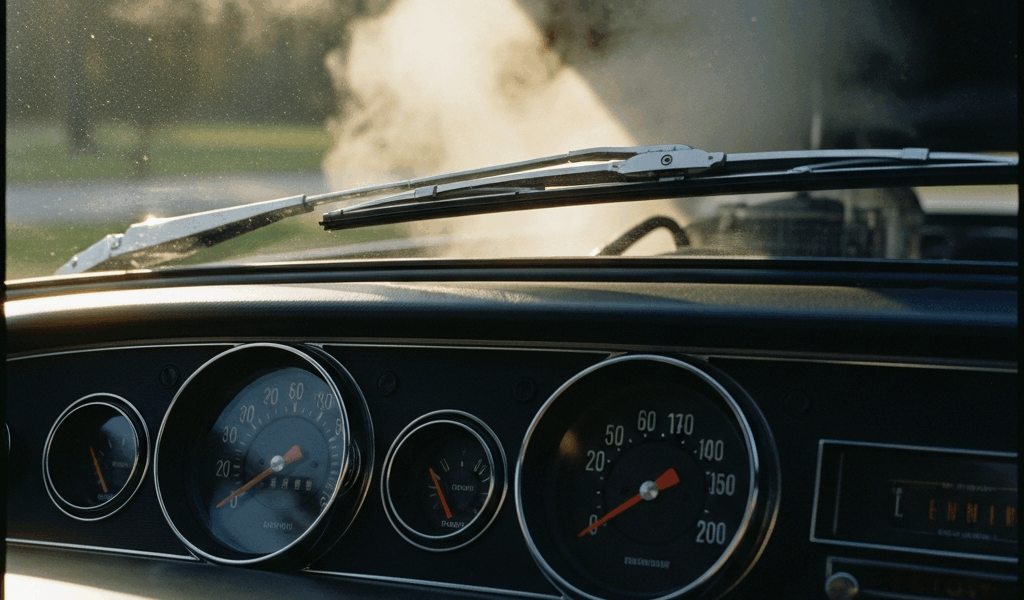
Why Classic Cars Overheat More Than Modern Ones
Classic car overheating has gotten complicated with all the bad advice flying around. And honestly, most of it misses the real issue entirely — these machines were engineered for a completely different world. Single-core radiators with narrow fin spacing clog easily. Water pumps from the 1960s wear out faster than you’d think — the seal fails, impeller vanes corrode, and flow drops without a single warning sign. Many classics still run straight water or that old green coolant, which chews through internals and leaves sediment everywhere. No overflow tank means lost coolant is just gone. And those temperature gauges? They lag behind actual head temps by 10 to 20 degrees. By the time the needle moves, you’re already in trouble.
Original copper and brass radiators fail differently than modern aluminum ones. Electrolysis happens when dissimilar metals meet in coolant — and that problem gets magnified in cars that sat for years or got “refreshed” with mismatched parts. The result is pinhole leaks nobody catches until coolant vanishes somewhere on Route 9 at 6 p.m. on a Friday.
Read the Symptom First — Slow Creep vs. Sudden Spike vs. Idle Only
Probably should have opened with this section, honestly. Most people call a mechanic and say “it overheats,” which tells us absolutely nothing useful. Temperature creeping upward on a highway run behaves completely differently than a sudden spike on a city street — or a car that runs fine at speed but boils the moment you sit in traffic. The symptom narrows your diagnosis from five possible causes down to one or two. That’s what makes symptom-reading so valuable to us classic car people.
Temperature Climbs Slowly on Highway Runs
You’re cruising at 55 mph. The needle drifts past the middle. Hit 65 and it climbs higher. No steam, no boiling — just a slow, steady rise. That pattern points almost immediately to restricted flow. The radiator can’t shed heat fast enough under sustained load. Low coolant produces the same symptom. So do air bubbles trapped in the system — pockets of air don’t conduct heat like liquid does, and they migrate to the worst possible spots.
Check the coolant level first. Seriously, most people skip this entirely. Pop the cap when the engine is cold and look inside. If it’s low, coolant is going somewhere — pinhole leak, bad cap, weeping water pump seal. Top it off and watch the level over the next week. Drops again? You have a leak to find before anything else matters.
Temperature Spikes Suddenly
Normal gauge one moment. Hard jump toward the red zone the next. You didn’t change speed. Traffic didn’t tighten. The thermostat probably stuck closed or the water pump just quit — those are your two most likely culprits. A stuck-open thermostat does the opposite, for what it’s worth. The gauge never climbs past cool because coolant cycles too fast. Sudden spikes mean circulation narrowed or stopped entirely. Simple as that.
Turn off the AC and watch the needle. Air conditioning load on a marginal cooling system can push it right over the edge. If the temperature drops when the AC cuts out, your system is running borderline and something — an air-locked thermostat, a weak pump — is the real problem underneath.
Overheats Only at Idle but Cools Moving
Sitting in traffic, temperature climbs toward hot. Start rolling, it drops back to normal. Textbook cooling fan failure — at least if you’re seeing this pattern consistently. When the car moves, ram air through the radiator does the work. The fan handles that same job when you’re stationary. No fan, no idle cooling. It really is that straightforward.
Listen for the fan while idling in park with the engine warm. You should hear it engage clearly. Many classics use mechanical fans driven by the water pump — these fail silently when the clutch wears out, which is annoying. Electric fans quit when the thermostat switch fails or the motor burns out. Both fail without much drama beforehand.
The Most Common Causes and How to Test Each One
Clogged Radiator — Most Likely
Pull a hose off the radiator with the engine cold. Point it at a five-gallon bucket and have someone start the engine and rev it gently. Strong flow means you’re clear. A weak trickle means the core is blocked. No guessing involved — this is a hands-on test with an immediate answer. Straight water leaves mineral deposits that calcify over decades. Electrolysis from mixed metals creates sludge. Both choke flow to almost nothing in a classic that’s been sitting since 1987.
Flushing runs $150 to $300 at a shop. A quality copper replacement radiator costs $400 to $800. Aluminum replacements come in around $250 to $500. A re-core — pulling your original shell to a radiator shop — runs $300 to $500 and keeps the car looking stock if originality matters to you.
Many chronic overheaters go straight to a three-row aluminum radiator rather than replacing the original single-core. You pick up roughly 40% more cooling capacity without major fabrication work. Griffin and Wizard Cooling both make direct-fit units for common classics. I’m apparently a Griffin person — their fitment on my 1968 Chevelle was dead-on while a generic unit I tried first never sealed right. Don’t make my mistake.
Faulty Thermostat — Second Most Common
But what is a stuck thermostat actually doing? In essence, it’s a valve that controls when coolant flows into the radiator. But it’s much more than that — it’s also what keeps your engine at proper operating temperature, which affects everything from fuel mixture to oil viscosity. Feel both radiator hoses when the engine is cold and freshly started. The lower hose should stay cool for the first 30 seconds, then warm gradually as the thermostat opens. Both hoses hot within 10 seconds? Thermostat is stuck open. Lower hose stone cold after a full minute of running? Stuck closed — and heat has nowhere to escape.
A stuck-closed stat spikes temperature fast. A stuck-open stat prevents proper warm-up. Classic thermostats fail both directions with equal enthusiasm. Replacement parts run $30 to $80. Labor adds $150 to $300. Most shops replace it automatically when overheating is the primary complaint — it’s the cheapest item on the list and it pays off if that was the actual culprit all along.
Dead Water Pump — Third Most Common
Grab the water pump pulley with a shop rag — engine off — and try to wiggle it side to side. Any play means a worn bearing. Some movement is expected, but more than a quarter-inch of side-to-side motion means failure is close. Spin the pulley by hand. It should turn smoothly and quietly. Grinding or rough resistance says the bearing is already shot.
Water pump seals fail after years of sitting idle. The seal dries out and coolant weeps from the small vent hole near the pump body. You’ll see green or orange staining below the pump — sometimes a thin mineral crust if it’s been going on a while. A failing pump can lose a quart a week without any obvious external leak. Full replacement costs $100 to $250 for the part itself, plus $200 to $400 in labor depending on how buried the pump is.
Air Lock in the System
Trapped air blocks circulation. Classic cars without overflow tanks are especially prone to this — particularly after a flush or repair job. The air pocket forms a vapor barrier that stops flow cold. Symptoms mirror a clogged radiator — slow heat buildup — but the fix is completely different, which is why symptom-reading only gets you so far.
Burp the system by removing the thermostat housing cap and running the engine until coolant flows steadily without bubbles breaking the surface. Some cars need the rear of the block bled manually through a separate plug. Your service manual for that specific model will tell you. Once bled, fill slowly and let the engine idle a full 10 minutes before you drive anywhere.
Collapsed Radiator Hose
A hose that looks perfectly fine outside can be deteriorating internally. When coolant pressure drops or the water pump draws suction, the hose collapses inward and blocks flow completely. Feel the lower radiator hose while the engine idles — it should feel firm and pressurized, not squishy or soft. Squeeze it gently. Original rubber hoses from the ’60s and early ’70s are basically on borrowed time at this point.
New radiator hoses run $20 to $50 each. Labor is minimal. If you’re already pulling hoses for a flush or radiator swap, just replace them while everything is apart. Preventive hose replacement makes obvious sense on any classic that’s pushing 40-plus years old — and most of them are now.
How to Fix an Overheating Classic Car Step by Step
Start with a cooling system flush and pressure test. Shops charge $150 to $250 for this. They pressurize the system to 16 psi and hold it for 15 minutes. A pressure drop reveals a leak. No drop means the system seals properly. That result tells you immediately whether you’re chasing a leak or a flow problem — two very different repair paths.
Replace the thermostat next — at least if you have no record of it ever being changed. It’s cheap insurance. Use a quality unit rated for your engine’s original temperature spec, typically 180°F or 195°F depending on the application. Check your shop manual. Don’t guess on this particular detail.
If you’re opening the cooling system anyway, inspect the water pump impeller while you’re in there. Some pumps let you peek at the fins directly. Corrosion or erosion means the pump won’t move coolant efficiently even when it turns freely. Replace it if there’s any real doubt — the incremental labor cost at that point is minimal.
Flush the radiator if the pressure test showed it’s intact but flow seems restricted. Chemical flush followed by reverse-flow pressure helps break loose decades of deposits. If the radiator leaks or flow stays poor after flushing, re-core it or replace it with a modern aluminum core. Aluminum dissipates heat roughly 20% more efficiently than original copper at the same physical size. That was a genuine engineering improvement — one of the few areas where newer actually is better for classic applications.
A common — and expensive — mistake is replacing the radiator before testing the thermostat or flushing the system. You spend $600 on a new radiator only to find a $40 thermostat was the actual villain the whole time. Start simple. Upgrade only when simple doesn’t solve it.
When to Stop Driving and Call a Tow
Steam from under the hood. That’s an immediate stop — no exceptions. Kill the engine. Call a tow. Coolant smell inside the cabin points to a leaking heater core, which is less urgent but still needs attention soon. Check the dipstick. If the oil looks like chocolate milk, coolant got into the crankcase. Head gasket failure or a cracked block did that. Do not start the engine again under any circumstances.
Running a classic hot even once can warp a cast-iron head. A second time risks a cracked block — and that ends the engine entirely. Prevention costs an afternoon and maybe $40 in parts. Repairs after the fact cost thousands. That’s what makes paying attention to the temperature gauge so critical for anyone driving these cars regularly.


Stay in the loop
Get the latest classic car craze updates delivered to your inbox.