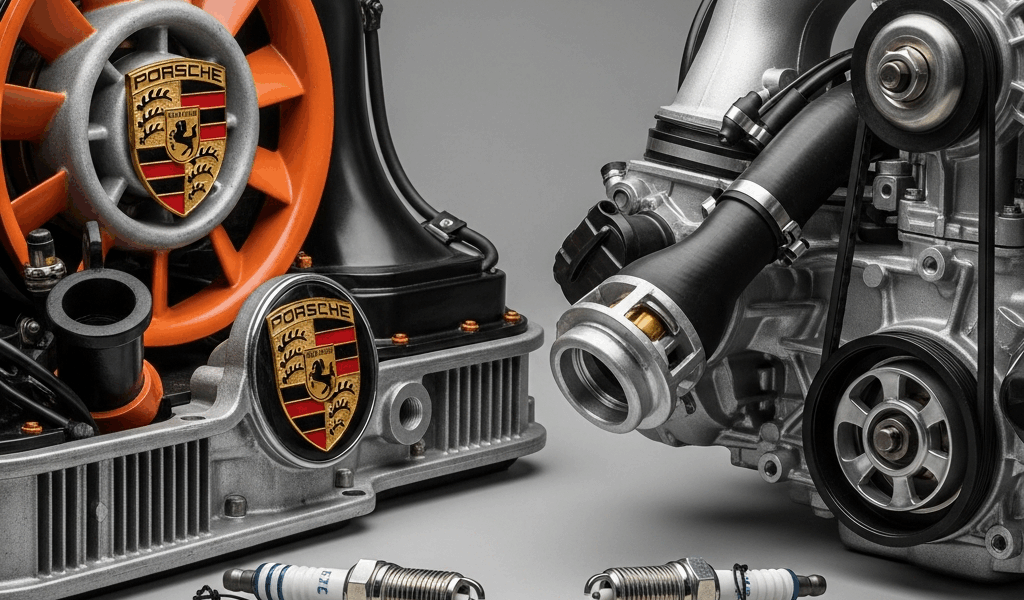
Porsche 911 Air-Cooled vs Water-Cooled — Why It Matters to Buyers
The porsche air cooled vs water cooled debate has split enthusiast forums, Porsche Club of America meetups, and Saturday morning garage conversations for over two decades. I’ve been on both sides of it. I owned a 1995 993 Carrera for four years, then sold it and bought a 2001 996 Carrera 4S. People thought I was crazy. Some of them still do. But having lived with both cars — through track days, daily commutes, two cross-country drives, and one genuinely terrifying moment on a wet mountain pass — I can tell you the debate is real, the differences are meaningful, and the right answer depends entirely on who you are and what you actually want from the car.
This isn’t a spec sheet comparison. You can find those anywhere. This is about what it actually feels like to own and drive both generations, what they cost you beyond the sticker price, and how to think clearly about which one belongs in your garage.
The Split — 1998 Was the Year Everything Changed
Porsche built air-cooled 911s for thirty-four years. Thirty-four years. The Beetle-derived flat-six that debuted in the original 901 in 1963 evolved continuously — displacement grew, fuel injection replaced carburetors, the engine moved and matured — but the fundamental cooling philosophy never changed. Air moved over finned cylinders. That was it. No radiators, no coolant passages, no water pump.
The 993, produced from 1994 through 1998, was the last of that lineage. It’s a genuinely beautiful machine — arguably the best-looking 911 ever built — and it represented the apex of what Porsche’s engineers could extract from the air-cooled concept. The 3.6-liter M64 engine made 272 horsepower in standard Carrera trim. The GT2 variant pushed that to 430 horsepower, still air-cooled, still remarkably composed. Porsche was proud of what they’d built.
They switched anyway.
The reasons were practical and relentless. California emissions regulations were tightening. European standards were following suit. An air-cooled engine is inherently harder to manage thermally with precision, which makes catalytic converter efficiency more difficult to optimize. The engineers at Weissach had been studying water-cooled designs for years, and the performance case was becoming undeniable — tighter tolerances, better thermal management, more consistent combustion temperatures, room for significant power increases without exotic metallurgy.
The 996, launched for the 1998 model year in Europe and 1999 in North America, introduced a 3.4-liter water-cooled flat-six producing 300 horsepower in base Carrera form. Twenty-eight more horsepower than the outgoing 993 Carrera, lighter overall, more fuel-efficient, and substantially cheaper to manufacture. Porsche also controversially shared the 996’s basic engine architecture with the Boxster, which did not go over well with 911 purists at the time and still causes grumbling today.
The 996 also wore a new body. Gone were the round “fried egg” headlights that had defined the 911 silhouette since 1963. The 996’s face was smoother, more integrated, and — depending on your aesthetic sensibility — either clean and modern or deeply soulless. That styling decision contributed to the 996 being undervalued for years.
Worth mentioning here: the 996 also came with a well-documented mechanical liability. The Intermediate Shaft bearing — the IMS bearing — was a known weak point in the M96 engine, and failures could destroy the entire powertrain. It was a real problem, it affected a meaningful percentage of cars, and if you’re seriously considering a 996, you need to research that issue thoroughly before buying. It’s been addressed retroactively with aftermarket bearing upgrades, but it’s part of the calculus.
Driving Experience — What Actually Feels Different
Here’s where the conversation gets genuinely interesting, and where I’ll be as specific as I can.
The Sound
Nothing prepares you for the sound of an air-cooled flat-six at high revs if you’ve only ever driven water-cooled cars. It’s mechanical in a way that feels almost agricultural at low speeds — there’s a clatter and a thrum that sounds, to untrained ears, like something is wrong. Nothing is wrong. That’s just what a 3.6-liter air-cooled engine sounds like at 1,500 rpm in third gear through a residential neighborhood.
Climb past 4,000 rpm and the character transforms. The note becomes harder, more insistent, almost industrial — like a very angry sewing machine scaled up to enormous proportions. At 6,000 rpm in a 993, approaching the 6,800 rpm redline, the sound is genuinely visceral. It’s loud inside the cabin. It fills the space around the car. People stop and look.
The 996 sounds good. It does. The water-cooled flat-six has a smoother, more refined note — higher-pitched, less mechanical, more “sports car” in the conventional sense. But it lacks that specific organic quality. My 996 sounded like a fast car. My 993 sounded like a 911.
I know how that reads. I’m aware it’s partly nostalgia. I’m telling you anyway.
Throttle Response and Engine Feel
Probably should have opened with this section, honestly, because this is where the real driving difference lives.
The air-cooled engine in the 993 is mechanically simpler in ways that translate directly to your right foot. Throttle inputs feel more immediate — there’s less thermal mass between what you ask for and what you get. Part of this is the engine’s architecture, part of it is the absence of coolant passages that add mass and complexity to the block. The result is a car that feels extremely alive to small inputs at the throttle pedal.
The 996 is more sophisticated. The engine management is more advanced — Bosch Motronic 7.8 in most variants — and the power delivery is smoother and more linear. That’s genuinely better in some contexts. On track, predictable power delivery is valuable. In wet conditions, the 996 is more forgiving. But the 993 has a rawness that’s difficult to describe without sounding like you’re trying too hard. It communicates more. Good and bad.
The Chassis and Handling
Both cars share the 911’s fundamental rear-engine layout, which means both will rotate dramatically if you lift off mid-corner at the limit. Neither is a car to take liberties with until you know it. I learned this the uncomfortable way in my 993 on a track day at Thunderhill Raceway — too much entry speed into the hairpin, a lift-off, and a moment of genuine pucker that I recovered from mostly through luck and partly through the car’s own stability.
The 993 chassis feels slightly more analog. The steering — hydraulic rack-and-pinion — has a tactile quality that communicates road texture directly to your palms. You can feel the difference between smooth asphalt and chip seal through the wheel. The 996 steering is also hydraulically assisted and communicates well, but it’s been tuned for a broader market, which means some of the sharpest edges have been sanded down slightly.
The 996’s suspension is more refined. Better high-speed stability. More composed on imperfect surfaces. As a driver’s tool, it is arguably the better chassis. As a driver’s experience, the 993 is more involving.
The Transmission
Both cars offered six-speed manuals (the G96 gearbox in the 996, the G50 in the 993) and both are excellent. The G50 has slightly longer throws and a more mechanical feel. The G96 is slicker and more modern. Porsche also offered the Tiptronic automatic in both generations — take the manual if you can find one. Not because the Tiptronic is bad, but because the manual transforms the driving experience in ways that matter.
The Value Gap — Why Air-Cooled Commands a Premium
Let’s be direct about money, because this is where the debate becomes a real decision for most buyers.
As of 2024, a clean, well-maintained 1995–1998 993 Carrera coupe in good condition sells for somewhere between $85,000 and $130,000 depending on mileage, color, service history, and whether the seller watches too much Bring a Trailer. A 993 Carrera S — the wider-body variant — starts around $120,000 and climbs from there. A 993 Turbo? Budget $200,000 to $300,000 for a legitimate example. More for the right color combination.
A comparable 1999–2004 996 Carrera coupe in similar condition costs $25,000 to $45,000. A 996 Turbo — which is a genuinely fast and capable car — runs $60,000 to $90,000. The gap is enormous.
Humbled by those price differences when I bought my 993 back in 2013 (paid $38,000 for it then — that number haunts me now), I understood intellectually that air-cooled cars were appreciated assets. What I didn’t fully grasp was the acceleration of that appreciation that was coming.
The premium exists for several compounding reasons. Supply is finite and non-replenishable — no more air-cooled 911s are being made, and the ones that exist are slowly being parted out, crashed, or preserved behind climate-controlled garage doors. Demand has grown as the generation that grew up watching these cars now has disposable income to spend. The 993 in particular benefits from being both the last air-cooled car and the most refined version of the type — a “best of” status that collectors reliably reward with dollars.
The 996, on the other hand, suffered a reputation hit from the IMS bearing issue and from its controversial styling, and those headwinds suppressed prices for years. That suppression is easing — 996 Turbos and GT3 variants have seen significant appreciation — but base Carrera 996s remain genuinely affordable in a way that no 993 will ever be again.
Running Costs
The 993’s air-cooled engine is simpler in some respects but parts availability is increasingly an issue. Independent specialists like Rothsport Racing or Callas Rennsport can rebuild and maintain them, but labor costs are real and parts for specific components — certain cam followers, specific gaskets — require hunting. Plan for $3,000 to $5,000 per year in maintenance if you’re driving the car regularly.
The 996 is cheaper to run in most scenarios. Parts are widely available, independent Porsche specialists are everywhere, and many components interchange with the Boxster. The IMS bearing issue, if addressed with an aftermarket upgrade like the LN Engineering kit (approximately $800–$1,200 parts and labor), removes the catastrophic failure risk. A well-maintained 996 can be run for $1,500 to $2,500 per year in regular servicing costs.
Neither car is cheap. Neither should be treated as a bargain-hunting exercise. Buy the best example you can find and pay a pre-purchase inspection fee — $300 to $500 at a qualified independent Porsche specialist — before writing any check.
Which Porsche 911 Should You Actually Buy
This is the question everything else feeds into. And I think most articles dance around it, offering vague “it depends” answers that leave you no better off than when you started. I’m going to try to be more useful than that.
If You Want a Daily Driver
Buy the 996. Full stop. It is more reliable in regular use, cheaper to maintain, easier to source parts for, and better equipped with modern amenities (air conditioning that actually works at highway speeds, a more refined ride). Find a 1999–2004 example with full service records, have the IMS bearing inspected or replaced, and drive it without guilt. It’s a Porsche 911. It will make every commute feel like something other than commuting.
The 993 as a daily driver is an exercise in either commitment or masochism. The air conditioning is marginal in serious heat. The reliability, while generally good, requires more attentive maintenance. More critically: driving a $100,000+ appreciating asset through road salt, traffic, and parking lots every day is a decision that will cost you money in either stress or resale value. Some people do it. I respect them. I wouldn’t do it.
If You Want a Weekend Car
This is where the answer genuinely splits based on your emotional relationship with the car.
If you want the most engaging, characterful, talkative driving experience — the car that makes you feel connected to thirty-four years of mechanical history every time you start it — buy the 993. Save up, buy the best example you can afford, and accept that you’re also buying an appreciating asset that may ultimately cost you very little to own when you account for value appreciation.
If you want a fantastic weekend sports car at a fraction of the price, with better performance metrics and less financial anxiety, buy the 996 Carrera or spring for a 996 Turbo if the budget allows. The Turbo in particular is still one of the best performance bargains in the used sports car market — 415 horsepower, all-wheel drive, sub-4-second 0-60 times, and prices that haven’t fully caught up to its capabilities.
If You’re Buying as an Investment
The 993 has been the cleaner investment story for twenty years and shows no signs of reversing. Air-cooled 911s in general — particularly in desirable configurations (Carrera S, Turbo, RS America, any motorsport homologation variant) — have appreciated consistently and significantly. The market has been volatile in specific moments but the long-term trajectory has been upward.
The 996 is a more speculative play. Base Carrera values are probably near floor — they’ve been cheap for so long that further depreciation seems unlikely. Turbo and GT3 variants have already begun appreciating meaningfully. If you’re buying a 996 as an investment, those variants are where the thesis is most defensible. Buying a base 996 as an investment is a longer and less certain bet.
If You Want a Track Car
Buy the 996. The water-cooled engine handles sustained high-RPM abuse more comfortably than the air-cooled unit, which is sensitive to oil temperature management in extended hard use. The 996’s engine management system is more sophisticated in ways that benefit track driving. Parts are cheaper when you break things (and you will break things). The 996 GT3 — if budget allows — is one of the great track cars of its era at any price point.
Tracking a 993 is absolutely done by serious club racers, and the car is capable of it. But you’re subjecting an appreciating collectible to mechanical stress and crash risk. That math gets harder to justify as 993 values climb.
The Honest Summary
Owning both cars taught me that the debate itself is a little false. These aren’t competing answers to the same question — they’re answers to different questions. The 993 asks: “What do you want to feel?” The 996 asks: “What do you want to do?”
Both are legitimate questions. The 993 is more emotional, more historically resonant, more expensive, and more demanding of your attention and budget. The 996 is more capable, more practical, more accessible, and more forgiving. Neither is the wrong car. The wrong car is the one you buy without understanding which question you’re actually trying to answer.
If I could only own one today, and I’m being honest with myself about how I actually use cars — weekend drives, occasional track days, the rare road trip — I’d buy a clean low-mileage 993 Carrera in Midnight Blue Metallic and accept the expense as the cost of owning something genuinely irreplaceable. But I live in Southern California where the salt is not an issue and the canyons are fifteen minutes away. Your answer might be different, and it should be.
Whatever you decide — get a pre-purchase inspection. Get the service records. Join a Porsche Club chapter in your area before you buy, not after. And drive both before committing. The 993 will tell you something about itself within the first



Stay in the loop
Get the latest classic car craze updates delivered to your inbox.