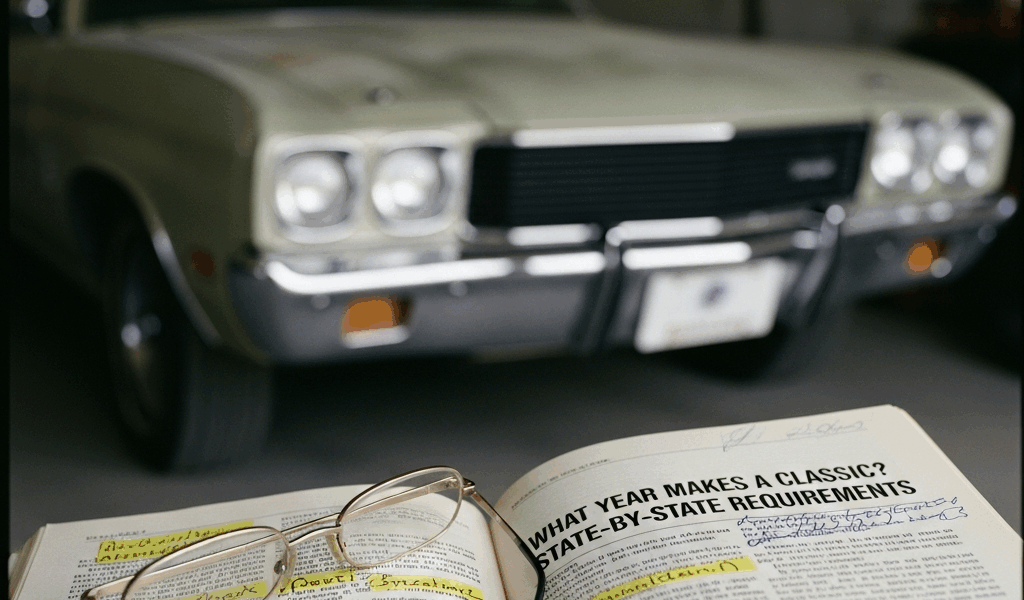
What Year Makes a Car a Classic? State-by-State Requirements
Classic car registration has gotten complicated with all the conflicting information flying around. As someone who moved from Ohio to Arizona hauling a 1978 Pontiac Firebird in a rented trailer, I learned everything there is to know about how badly this process can go wrong. I assumed my Ohio antique plates would transfer. They did not. Ohio had signed off on my car at 25 years old. Arizona had its own rules, its own paperwork, its own fees — and zero interest in what Ohio thought. Three DMV trips and $94 later, I walked out with Arizona historic vehicle plates and a hard-won education I probably should have gotten before loading up that trailer.
Here’s the short version: there is no federal standard. None. The IRS doesn’t define “classic car.” The DMV doesn’t run on a national rulebook. Every state wrote its own definition, and some of those definitions are surprisingly sharp while others are frustratingly fuzzy. If you’re trying to figure out whether your car qualifies — for special plates, reduced registration fees, or insurance purposes — you need to know your specific state’s rules. Full stop.
The Short Answer — It Depends on Your State
But what is a “classic car” threshold, legally speaking? In essence, it’s the minimum age your vehicle must reach before your state will classify it under a special registration category. But it’s much more than that — it’s also a set of use restrictions, fee structures, and sometimes emissions exemptions that come bundled with that classification.
Most states cluster around three age cutoffs: 20 years, 25 years, or 30 years. A smaller number land at 15 years or 35 years. A handful tack on extra criteria beyond age — things like requiring the car to be “substantially unaltered from the original manufacturer’s specifications” or capping annual mileage somewhere between 1,000 and 7,500 miles. Age gets you in the door. It doesn’t always get you across the finish line.
Stumbled into this research project sideways, honestly — what started as fixing my own registration mess turned into four months of calling DMV offices, reading actual state statutes, and cross-referencing insurance guidelines. The information online is scattered and often embarrassingly outdated. Some articles are still citing laws amended back in 2019. I’ve pulled the most current requirements I could find, but before you make any real registration decision, call your state DMV directly. Don’t make my mistake of assuming the internet has it right.
Here’s what the broad landscape looks like:
- 20-year threshold states: Relatively uncommon. States using this cutoff tend to prefer the term “classic” over “antique.”
- 25-year threshold states: The most common cutoff in the country — and also the threshold used by major classic car insurers like Hagerty and Grundy.
- 30-year threshold states: Several states, particularly scattered across the South and Midwest, push to 30 years for their most favorable registration tier.
- Variable threshold states: A few states run tiered systems — one classification kicks in at 20 years, a different and more favorable one at 25 or 30.
Probably should have opened with this section, honestly — a lot of people land on this question expecting one clean answer. There isn’t one. “What year makes a car a classic?” is really asking: old enough according to whom?
State-by-State Classic Car Age Requirements
The table below covers all 50 states. The “Official Name” column reflects the exact term used in each state’s vehicle code — and those terms carry real legal weight, which I’ll get into after the table. Restrictions listed are the most common ones attached to each classification. Some states pile on additional requirements not captured here.
| State | Age Threshold | Official Classification Name | Key Restrictions |
|---|---|---|---|
| Alabama | 25 years | Antique Vehicle | No commercial use; pleasure driving only |
| Alaska | 25 years | Collector Vehicle | No daily use; must be maintained for show or collection |
| Arizona | 25 years | Historic Vehicle | No commercial use; emissions exempt |
| Arkansas | 25 years | Antique Vehicle | Pleasure driving only; no mileage cap stated |
| California | 1973 or older (pre-1976 for some programs) | Historical Vehicle | Limited to 5,000 miles/year; smog exempt |
| Colorado | 25 years | Collector Vehicle | No commercial use; no stated mileage cap |
| Connecticut | 20 years | Antique, Historic, or Special Interest | Pleasure driving and exhibitions only |
| Delaware | 25 years | Antique Vehicle | Pleasure use only; not for daily transportation |
| Florida | 30 years | Antique Vehicle | Not for hire; can be used for tours, exhibitions, parades |
| Georgia | 25 years | Antique Vehicle | Not for hire; pleasure or exhibition use |
| Hawaii | 25 years | Antique Vehicle | Limited to exhibitions, parades, and occasional pleasure driving |
| Idaho | 25 years | Classic Vehicle | No daily use requirement; broad pleasure use allowed |
| Illinois | 25 years | Antique Vehicle | Pleasure use; not for commercial or regular transportation |
| Indiana | 25 years | Antique Vehicle | Pleasure use only; parades and exhibitions allowed |
| Iowa | 25 years | Antique Vehicle | No regular transportation; exhibition and pleasure use only |
| Kansas | 35 years | Antique Vehicle | Pleasure and exhibition use only |
| Kentucky | 25 years | Antique Vehicle | Pleasure use; no commercial purpose |
| Louisiana | 25 years | Antique Vehicle | Pleasure, parades, and exhibitions; no daily commuting |
| Maine | 25 years | Antique Auto | Pleasure use and exhibitions; not for regular transportation |
| Maryland | 20 years | Historic Motor Vehicle | Pleasure, exhibition, and club activities only |
| Massachusetts | 25 years | Antique Motor Car | No regular use; limited to exhibitions and pleasure trips |
| Michigan | 26 years | Historic Vehicle | Pleasure use; no commercial transport |
| Minnesota | 20 years | Collector Passenger Vehicle | Limited to exhibitions and occasional pleasure use |
| Mississippi | 25 years | Antique Vehicle | Pleasure driving; not for regular transportation |
| Missouri | 25 years | Antique Motor Vehicle | No commercial use; pleasure and exhibition |
| Montana | 30 years | Vintage Vehicle | Pleasure and exhibition use; no commercial application |
| Nebraska | 30 years | Collector Vehicle | No commercial use; must be maintained in condition for exhibition |
| Nevada | 40 years (for special interest plates) | Classic Rod / Antique | Pleasure use; no commercial transport allowed |
| New Hampshire | 25 years | Antique Vehicle | Pleasure and exhibition; not for regular use |
| New Jersey | 25 years | Classic/Antique Vehicle | Not for regular use; pleasure driving permitted |
| New Mexico | 25 years | Antique Vehicle | Pleasure use only; no commercial application |
| New York | 25 years | Antique Vehicle | Limited to exhibitions and pleasure; not for hire |
| North Carolina | 30 years | Antique Vehicle | Not for hire; pleasure and exhibition use permitted |
| North Dakota | 25 years | Collector Vehicle | Pleasure use; no daily transportation |
| Ohio | 25 years | Antique Motor Vehicle | Pleasure use; not for commercial transport |
| Oklahoma | 25 years | Classic Car | Pleasure and exhibition; no commercial use |
| Oregon | 25 years | Antique Vehicle | Pleasure use; not for regular daily transportation |
| Pennsylvania | 15 years (Classic); 25 years (Antique) | Classic / Antique | Varies by tier; antique has more restrictions than classic |
| Rhode Island | 25 years | Antique Motor Car | Pleasure and exhibition; not for regular use |
| South Carolina | 25 years | Antique Motor Vehicle | Not for hire; pleasure use and exhibitions allowed |
| South Dakota | 30 years | Antique Vehicle | No commercial use; pleasure and exhibition |
| Tennessee | 25 years | Antique Motor Vehicle | Pleasure and exhibition; no daily transportation |
| Texas | 25 years | Antique Vehicle | Pleasure use only; no commercial transport |
| Utah | 40 years | Classic Vehicle | No commercial use; show, exhibition, and pleasure use |
| Vermont | 25 years | Antique Motor Vehicle | Pleasure and exhibition; not for regular use |
| Virginia | 25 years | Antique Motor Vehicle | Pleasure and exhibition; no commercial use |
| Washington | 30 years | Horseless Carriage / Classic Vehicle | Pleasure, exhibitions, parades; no daily driving |
| West Virginia | 25 years | Antique Motor Vehicle | Pleasure use; not for hire or commercial purposes |
| Wisconsin | 20 years | Collector Vehicle | Not for regular transportation; exhibitions and pleasure |
| Wyoming | 30 years | Antique Vehicle | Pleasure and exhibition; no commercial transport |
A few outliers worth flagging directly: Nevada’s 40-year threshold genuinely surprised me the first time I saw it. Utah sitting at 40 years is similarly conservative — that’s a tight window for a lot of enthusiasts. California is its own thing entirely. No rolling threshold. Instead, it uses a fixed model year cutoff — currently pre-1976 for most purposes — which means the qualifying pool doesn’t expand every year the way it does everywhere else. Pennsylvania’s two-tier setup at 15 and 25 years is actually pretty clever. If you have something old enough to hit “classic” but not old enough for “antique,” you’re not left empty-handed.
Classic vs Antique vs Vintage — The Terminology Matters
This is the part that trips people up constantly — and it tripped me up early on too. “Classic,” “antique,” and “vintage” feel completely interchangeable in everyday conversation. Inside state vehicle codes, they are frequently separate legal categories with different rules, different fees, and different use restrictions attached to each one.
What “Antique” Usually Means
Most states using “antique” attach stricter use restrictions to that label. We’re talking exhibitions, parades, club activities, and occasional pleasure driving — not your Tuesday morning commute, not grocery runs, not the school pickup line. The trade-off is usually a flat annual registration fee, often somewhere between $8 and $25, versus a standard registration that might run $150 to $300 depending on your state and what your vehicle is worth.
Back in Ohio, my Firebird’s annual registration was $31. Flat. Didn’t fluctuate. Didn’t factor in vehicle weight or assessed value. Just $31 every year — and that’s a real benefit, especially now that standard registration fees have been quietly climbing in a lot of states.
What “Classic” Usually Means
States that treat “classic” as its own legal category — rather than just a synonym for antique — tend to allow more generous road use. Pennsylvania’s classic designation for 15-year-and-older vehicles permits more regular driving than its antique classification does. Idaho’s classic vehicle plates don’t carry the same tight restrictions you’d find under antique designations elsewhere.
That’s what makes the “classic” label endearing to us drivers who actually want to put miles on a car. It signals: this vehicle is old, it’s being preserved, but it still belongs on the road. Not a museum piece. Not a trailer queen. That distinction matters a lot if you’re planning to drive rather than just show.
What “Vintage” and “Historic” Mean
Montana went with “vintage.” Arizona landed on “historic.” Several states use “historic motor vehicle” as their main classification. These terms don’t follow any consistent national logic — Montana’s vintage label kicks in at 30 years, while a state using “historic” might set its threshold at 20 or 25. You cannot look at the label alone and infer the age cutoff or the restrictions. You have to read the actual statute. Apparently some people learn this the hard way. I was one of them.
The Antique Automobile Club of America uses a 25-year threshold for its own antique vehicle definition. Hagerty’s insurance eligibility generally starts at 20 to 25 years depending on the program. The Classic Car Club of America — the CCCA — runs one of the most restrictive definitions in the entire hobby. They only recognize specific makes and models from roughly 1915 to 1948 as “Full Classics,” regardless of age. None of these private definitions carry any legal weight at the DMV, but they do affect your insurance options and club eligibility in ways that can matter quite a bit.
The Emissions and Inspection Angle
Beyond plates and fees, the classification also determines whether your car needs to pass emissions testing or a standard safety inspection — and this is where the financial math can shift significantly. California’s historical vehicle program exempts qualifying cars from smog checks entirely. Arizona’s historic vehicle classification carries an emissions exemption. Several other states quietly waive inspection requirements for vehicles meeting their antique or historic thresholds.
This might be the best reason to pursue a special classification, as the classic car registration process requires navigating both registration costs and ongoing compliance costs. That is because emissions testing and inspections — depending on your state — can run anywhere from $20 to well over $100 annually, and older vehicles don’t always pass easily. An exemption isn’t just a convenience. It’s real money, and for some vehicles, it’s the difference between road-legal and permanently parked.
While you won’t need a law degree to get through this process, you will need a handful of specific documents — typically proof of vehicle age, proof of ownership, and sometimes photographs or an inspection confirming the vehicle’s condition. First, you should pull your state’s actual DMV page for historic or antique vehicles — at least if you want accurate, current information rather than outdated forum posts from 2017. Requirements do change. Fees get revised. Classification rules get amended. The DMV website is not always a pleasure to navigate, but it is the only source that matters.



Stay in the loop
Get the latest classic car craze updates delivered to your inbox.