What Transmission Slipping Actually Feels Like
Classic car transmission problems have gotten complicated with all the misinformation flying around. So let me cut straight to it — slipping has a specific, unmistakable feel, and once you know it, you can’t unknow it. You’re sitting at a stoplight. RPMs climb from 800 to 2,000. The car goes nowhere. That’s it. That’s the whole sensation right there.
In a TH350 or Powerglide automatic, slipping announces itself as delayed engagement. You drop it into Drive or Reverse, the engine revs up, and then — sometimes after a full 2 or 3 seconds — it finally grabs. Sometimes that grab is smooth. Sometimes it’s a lurch that rattles your teeth. Either way, you feel it every single time you leave a stop sign.
Manual transmissions slip too, though the feel is completely different. Clutch pedal releases, engine is sitting at 3,000 RPM, and the car just… doesn’t go. Road speed crawls while engine noise stays high. The friction disc isn’t gripping the flywheel properly — that’s the whole problem distilled down to one sentence. Probably should have opened with this section, honestly, because misdiagnosing slipping as something else sends you down expensive rabbit holes that lead nowhere useful.
There’s also a third symptom some classic cars throw at you — unexpected downshifts. Powerglide cruising at 45 mph in high gear suddenly drops back to low for no reason. Engine roars. Transmission feels confused. That’s almost always a vacuum modulator giving up the ghost, a failure mode that’s basically exclusive to pre-1980s automatics.
Most Common Causes in Classic Car Transmissions
Low or Degraded Transmission Fluid
Start here. Always start here. Fluid does three jobs — lubricates, cools, and creates hydraulic pressure. When level drops or the fluid oxidizes into that dark brown, burnt-smelling mess, the transmission can’t hold pressure and the friction material isn’t being squeezed hard enough to do its job.
Here’s what’s sneaky about classic cars with sealed transmissions: a slow leak can hide for months. A TH350 holds roughly 3 quarts in the pan. Lose half a quart and you’ll never notice. Lose 1.5 quarts and you absolutely will — the hard way, at an intersection, in July.
Worn Clutch Packs in Automatics
The friction material inside automatic clutch packs wears out. No way around it. Powerglides and TH350s that have been driven hard — heavy acceleration, towing, years of stop-and-go — get their packs hammered. The material erodes. Engagement weakens. Slipping creeps in gradually until one day third gear just isn’t happening anymore.
Once it starts, it snowballs. Worn packs generate heat and metallic debris. That debris circulates through the fluid, accelerating wear on everything else it touches. Catching this early isn’t just smart — it’s the difference between a $40 fluid change and a $1,800 rebuild.
Worn Friction Discs in Manuals
Manual slipping points directly at the clutch disc. The facing material — the part that actually contacts the flywheel — has a finite lifespan. High mileage wears it down. Riding the clutch at every stoplight wears it down faster. Aggressive launches off the line? Even faster.
But here’s what catches people off guard with classics: age matters independently of mileage. A clutch disc from 1978 sitting in a garage for 30 years can harden and glaze over completely. Reduced grip, even with barely any miles on it. Don’t make my mistake of assuming low-mileage means healthy clutch.
Vacuum Modulator Failure
This part is essentially a vintage-only problem. It reads engine vacuum and tells the transmission what pressure to run at. When it fails, the transmission runs at wrong pressure — too low means slipping, too high means harsh shifts that feel like someone kicked the back of the car.
A leaking modulator is the worst version of this. The diaphragm inside ruptures and starts pulling transmission fluid directly into the intake manifold. You’re losing fluid and pressure at the same time, and you might not notice until you smell something burning. Common failure point on Powerglides and early Turbo 350s — worth checking before anything else on those platforms.
Band Adjustment Issues
Automatic transmissions use bands alongside clutch packs. These bands wrap around drums and clamp down to create gear engagement. A band that’s lost adjustment can’t grip the drum properly — slipping follows immediately.
On a TH350, the intermediate band adjuster sits right on the outside of the case. Visible, accessible, fixable with a basic wrench. That’s what makes the TH350 endearing to us classic car folks — it was designed to be serviced by actual human beings.
How to Diagnose the Problem Yourself
Step 1: Check Fluid Level and Condition
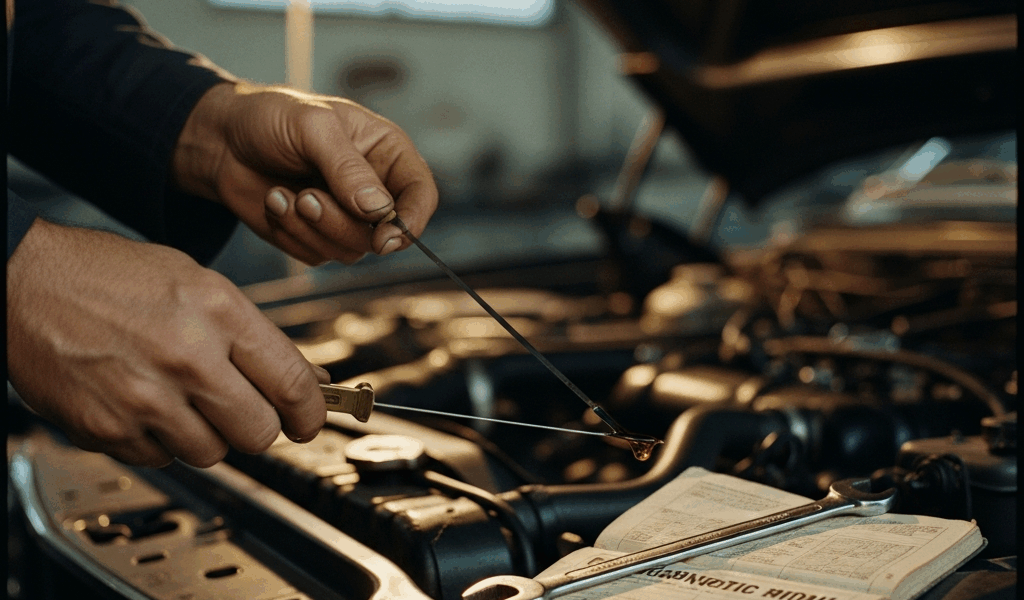
Warm the engine to full operating temperature first. Shift through every gear — Park, Reverse, Neutral, Drive, all the way down through the lower ranges — then settle it back to Park or Neutral at idle. Pull the dipstick, wipe it, reinsert it fully, pull it again. Read the level.
Should sit at the full mark. A half-inch low, top it off — but use the right fluid type. This matters more than most people realize. Some TH350s run Dexron just fine, but older models and Powerglides often want Type F. Those two fluids are not interchangeable. Check your owner’s manual or just call a transmission shop with your year and VIN.
Now smell it. Fresh fluid is faintly sweet, almost odorless. Burnt fluid smells acrid — like overcooked oil left on a stove. Check the color too. Red or pink is normal. Dark brown or black means it’s oxidized and done. Gritty texture or visible debris floating in it means internal wear particles are circulating, and that’s a much bigger conversation.
Step 2: Inspect for External Leaks
Park on clean concrete or cardboard. Look under the transmission pan for drips. Check the dipstick tube seal, the pan gasket perimeter, and around the torque converter area. Slow weeps often leave faint staining without any visible pooling — easy to miss unless you’re actually looking.
Then run the engine and look again while it’s under pressure. Some leaks only show up when the system is pressurized. A leak at the pan gasket is a straightforward reseal job. A leak from deeper internal sources is a different problem entirely.
Step 3: Test the Vacuum Modulator
Applies only to vintage automatics — you’ll see the modulator as a cylindrical canister roughly 2 inches long on the side of the transmission case, with a small vacuum hose running to the intake manifold.
Disconnect that hose and look inside. Transmission fluid in there means the diaphragm ruptured. It’s dead. Order a replacement — they typically run $40–80 and the job takes 10 minutes.
If it’s dry, grab a hand vacuum pump. Harbor Freight sells them for around $15. Connect it to the modulator port and pull vacuum. The plunger should move smoothly and hold steady. Jumpy vacuum reading or no movement at all — it’s failing and needs replacement.
Step 4: Check Band Adjustment
On a TH350, find the intermediate band adjuster on the driver’s side of the case — a bolt with a locking nut. Loosen the locking nut. Torque the center bolt to exactly 3 foot-pounds. Back it off 2.5 turns. Lock the nut back down.
That’s the whole procedure. Won’t save a band that’s already worn through, but for mild slipping caused by gradual loosening, this five-minute fix sometimes cures it completely at zero cost — at least if you already own a torque wrench.
How to Fix It Based on What You Found
DIY Fixes You Can Handle
Low or dirty fluid means a fluid service. Drain the pan — expect 2 to 3 quarts to come out. Replace the internal filter if your transmission has one. Clean any sludge from the pan. Refill with fresh fluid. A quality synthetic transmission fluid runs $8 to $15 per quart, so total out-of-pocket lands around $30 to $50 depending on what you buy.
Modulator replacement is another home-mechanic job. Unbolt it, pull it free, install the new one, reconnect the vacuum hose. Twenty minutes, maybe less. Parts cost $40 to $80.
Band adjustment on a TH350 costs nothing if you have a torque wrench and takes less time than it took to read this section.
When You Need a Rebuild
Worn clutch packs or badly worn bands require internal work — not a driveway situation. A professional TH350 rebuild runs $1,200 to $2,200 depending on the shop and what they find inside. Powerglide rebuilds typically land at $800 to $1,500. Manual clutch replacement runs $400 to $800, higher if the flywheel needs resurfacing, which it often does on high-mileage cars.
Before authorizing any rebuild, get a second opinion from a transmission specialist specifically. They can tell you whether the slipping is early-stage — potentially reversible with fluid treatment or minor adjustment — versus full internal damage requiring complete teardown. That distinction is worth another diagnostic fee.
How to Prevent Transmission Slipping Long Term
Use the correct fluid for your specific transmission — not a close substitute, not a universal blend. I’m apparently sensitive to this point, and using the right fluid type works for transmission longevity while mixing types never does. Viscosity problems and pressure loss follow fluid incompatibility reliably.
Change fluid every 30,000 miles under regular driving conditions, or every 2 to 3 years even if the car mostly sits. Stored fluid oxidizes slowly, building varnish deposits that restrict the small hydraulic passages the transmission depends on. Fresh fluid is the cheapest insurance available.
While you won’t need a full cooling system overhaul, you will need a transmission cooler if you tow anything or drive in summer heat regularly. A decent external cooler runs $150 to $300 installed — a small number compared to a rebuild bill.
One more thing: let the engine idle for at least 30 seconds after a cold start, then drive gently until the transmission reaches operating temperature. Cold fluid is thick and slow to pressurize. Hammering the throttle before the fluid is warm accelerates clutch pack wear faster than almost anything else you can do to a classic car transmission.
Catch slipping early. Address it immediately — whether that means a $40 fluid change or a call to a transmission specialist. The cost difference between early intervention and a full rebuild is measured in thousands of dollars.

Stay in the loop
Get the latest classic car craze updates delivered to your inbox.