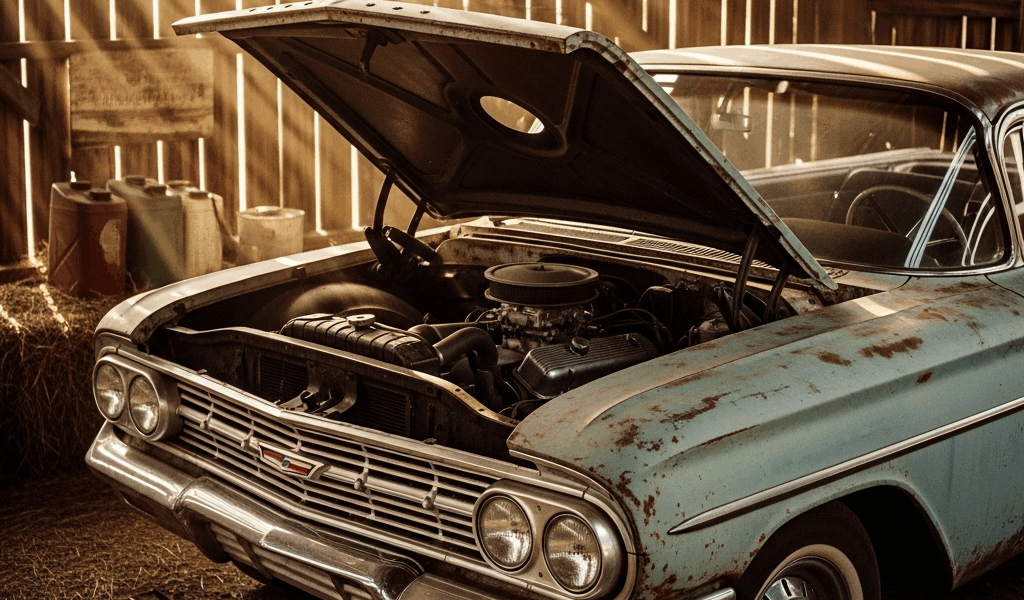
A 1960 Chevrolet El Camino — equipped with its original 348 cubic-inch tri-power V8 — has been pulled from a barn after sitting untouched since 1993. The team that revived it got the engine running under its own power. Hagerty Media produced the episode for its Driveway Finds series, publishing it to YouTube on March 23, 2026, and interest has been building ever since.
The car’s history is straightforward and a little heartbreaking. A farmer bought it new in 1960 and drove it hard — hard enough to bottom it out on rough country roads, throw sparks, and rip the front sway bar clean off. He parked it in the early 1990s with a restoration in mind that never materialized. His grandson, Bill, took it on one last drive in 1993 — a short loop around the neighborhood — and that was the end of it. When Driveway Finds hosts showed up 33 years later, they found flat tires, a seized shifter, a locked-up engine, and an interior that, per one report, had been “leased long-term by rodents.”
Why This One Matters
First-generation El Caminos were built for 1959 and 1960 only. Total production across both years was just 36,409 units — and Chevrolet shelved the nameplate after 1960, when only 14,163 were built, due to disappointing sales. How many left the factory with the 348 Tri-Power is unknown, but the number is presumed to be very small.
The engine suffix code is where this particular car separates itself. Stamped into the block: FH. That two-letter designation confirms a solid-lifter 348 in full tri-power trim — Chevrolet’s “Super Turbo Thrust” configuration, running three two-barrel carburetors and rated at 335 horsepower from the factory. For context, the top Corvette of 1960 used a small-block 283 with Ramjet fuel injection, good for 315 hp. This El Camino out-powered it by 20 horsepower. It also weighs only a few hundred pounds more than a contemporary Corvette. Chevrolet, essentially, built a hay-hauling street sleeper before the concept had a name.
The team didn’t stop at the suffix code. Fuel line routing, a firewall-mounted coil, a ballast resistor, and date codes all confirmed a factory-correct, matching-numbers setup. That corroborating physical evidence mattered — the VIN and trim tag alone can’t prove tri-power specification on these cars.
The Revival
Getting the car out of the barn meant ditching the winch and calling in a four-wheel-drive Suburban. Three of the four tires surprisingly held air once filled, which helped with loading. The engine was a different problem entirely.
Rust had seized the pistons in their bores — the likely culprit being a blown head gasket or cracked head that had let moisture in over the decades. The team soaked the cylinders with an acetone and transmission fluid mixture, let it dwell for days, then broke the engine free using a long pry bar and eventually the starter motor itself. From there: timing adjusted by hand, WD-40 on the valves, gasoline poured directly into each carburetor throat.
The 348 fired. It ran well enough that one host rode the fender spraying carburetor cleaner while the other drove it down the road and back. A pressure wash and a pass with a buffer revealed black finish underneath the grime that looked considerably better than expected. When Bill returned to the shop and saw his grandfather’s truck running again, the reaction spoke for itself.
What to Watch
The car has not been listed for sale, and ownership remains with the family as far as any source has reported. The Driveway Finds episode ends with the hosts explicitly asking viewers whether they’d like to see the 348 fully rebuilt — a strong signal that a follow-up is coming. Driver-quality 1960 El Camino 348 Tri-Power four-speeds currently fetch $40,000–$65,000 according to Classic.com data. A documented, matching-numbers survivor with confirmed FH-code tri-power? That’s a different conversation entirely for the right buyer.


Stay in the loop
Get the latest classic car craze updates delivered to your inbox.