“`html
Where Classic Car Transmission Leaks Show Up First
Classic car transmission fluid leaks don’t always announce themselves with dramatic pooling — I learned that the hard way. Spent three weekends chasing what I thought was a major rear main seal leak on my 1973 Chevy C10 before realizing the real culprit was a weeping pan gasket. That thing only left traces when the truck sat overnight. Frustrating doesn’t quite cover it.
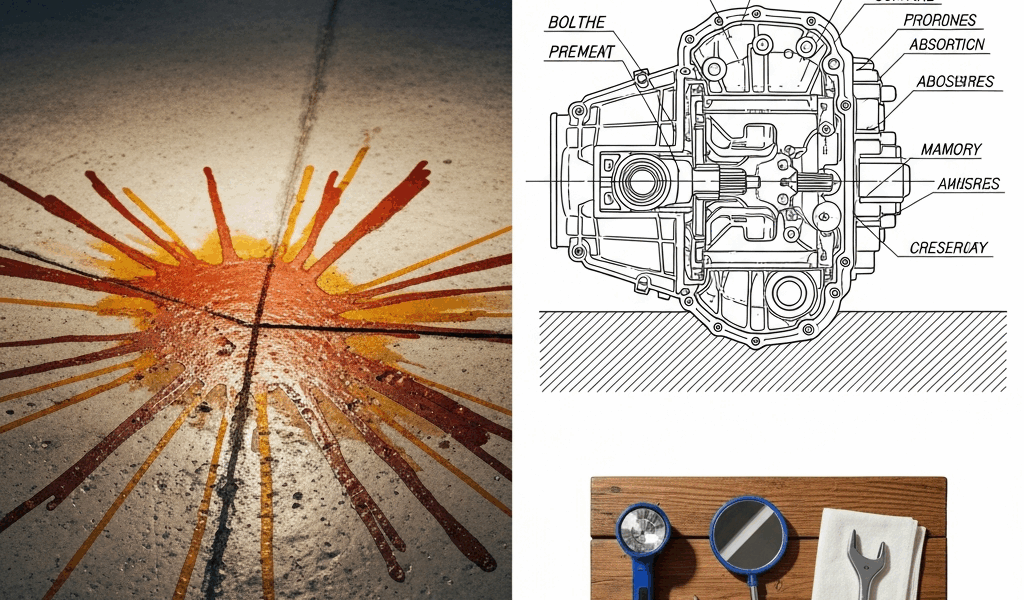
The fluid itself tells you plenty. Automatic transmission fluid (ATF) in vintage cars typically shows up as bright red or dark burgundy — almost wine-colored if it’s been overheated and oxidized. Manual transmission gear oil? That’s the darker cousin: amber to brown, sometimes nearly black. Consistency matters too. ATF flows like water. Gear oil clings thicker, like honey.
Here’s where to actually look. Get under the car with a trouble light — seriously, don’t skip this. On most classics, the transmission sits between engine and rear wheels. Leaks pool directly beneath the transmission case, the pan (that large sheet metal reservoir on the bottom), or along the extension housing where the driveshaft connects. I’ve found that older cars with non-sealed differentials disguise transmission leaks because gear oil from both systems looks identical.
The pan gasket is the first suspect, and for good reason. On a 1960s GM automatic, that gasket runs around the entire bottom perimeter — a common failure point because vintage gaskets hardened over decades. Manual transmissions? You’re looking at the main case seals and shift cover area. Fluid weeping from the shift lever on a manual? That’s usually the top cover gasket, easily spotted if you look down at where the shifter meets the transmission.
Don’t overlook the cooler lines if your car has an automatic. Those rubber or steel tubes run from the transmission to the radiator. A slow seep at a fitting wasn’t uncommon on 1970s Fords and Chryslers — sometimes just a 15-cent crush washer was the culprit.
Step-by-Step Leak Source Identification
Probably should have opened with this section, honestly. A systematic approach beats random guessing every single time.
Step 1 — Park on Clean Concrete
Move the car to a clean, level surface and let it sit overnight. That’s when fluid actually pools. Mud and dirt hide everything. I use a piece of white cardboard under the leak to see the color clearly — essential for distinguishing transmission fluid from coolant or engine oil. It’s a small detail that saves hours of confusion.
Step 2 — Check Your Dipstick Level
Warm the engine up (but not hot) and park on flat ground. Pull the dipstick. Automatic transmissions need this measurement. Low fluid confirms a leak rather than a simple overfill situation. On manuals, you’ll check a side-fill plug instead — most don’t have dipsticks. The level should reach the full mark. Anything below the low mark means you’re losing fluid somewhere, and it’s not by accident.
Step 3 — Assess Fluid Condition
Wipe the dipstick on a light rag and actually look at it. Fresh ATF is translucent red. Degraded fluid is opaque dark burgundy or brown, sometimes with a burnt smell that’s unmistakable. Manual gear oil should be amber to brown. If the fluid smells like burned chocolate, internal transmission damage might already be present — not just a seal leak. Metallic particles on the rag? That indicates wear inside the case, and that’s worth noting.
Step 4 — Inspect the Pan Gasket
Get under the car with a bright light and look at the pan edges where the gasket sits. Dried, crusty fluid buildup is the smoking gun. On automatics, the pan bolts might be loose — torque them to 80–120 inch-pounds on most vintage cars, depending on your specific model. On manuals, the drain plug at the pan bottom is worth checking. A loose plug might explain sudden fluid loss.
Step 5 — Check Input and Output Seals
The input seal (where the driveshaft enters the transmission) and output seal (where the output shaft meets the differential) are common leak points. Look for fluid collecting around these areas. A small weep is normal. A steady drip means replacement time. These require transmission removal on virtually all vintage cars — that’s the tough part.
Step 6 — Examine the Shift Cover
On manuals, the shift cover at the top of the transmission is accessible without removal. Bolt it back down securely if it’s loose. On automatics, you’ll rarely have access here without dropping the pan, but check that the dipstick tube seal is tight. Sometimes that’s all it takes.
Step 7 — Trace the Cooler Lines
Follow the rubber hoses from the transmission toward the radiator and look for weeping at the fittings. A simple tightening might solve it. If the hose itself is cracked, replacement is necessary — expect to pay $40–80 for quality rubber cooler lines plus hose clamps. Not bad, honestly.
Common Leak Points in Vintage Manual vs Automatic
Manual and automatic transmissions fail differently, and understanding which applies to your car saves real time.
Manual Transmission Leak Suspects
The input shaft seal is a frequent offender. On a 1968 Chevy Muncie 4-speed, this sits where the engine’s output shaft meets the transmission. Pressure from gear churning slowly pushes oil past a degraded seal lip. The output shaft seal behaves similarly — years of movement and temperature cycling harden the rubber until it weeps.
Shift cover gaskets fail because old cork hardened to the consistency of ceramic. I replaced one on a 1970 Ford — the gasket crumbled during removal, just turned to dust in my hands. The rear extension housing seal on most manuals, especially those paired with longer driveshafts, bears constant stress from drivetrain torque.
On a Tremec or T5 transmission found in 1980s and 1990s classics, the input seal is the weak point. On older Saginaw or Borg-Warner units from the 1960s, you’re more likely to see pan gasket failure first because those transmissions sat lower with exposed pans.
Automatic Transmission Leak Suspects
The pan gasket is number one, and it’s actually manageable. A 1967 Turbo 400 pan gasket costs about $8 and takes 90 minutes to replace if nothing else complicates matters. The filter seal sits underneath — access it when you drop the pan anyway.
The transmission cooler lines are second. On Chrysler TorqueFlites and GM Powerglides, these ran externally to the radiator core. A 1975 Ford C6 might develop slow leaks at the line fittings simply from age and vibration. The crush washer inside the fitting eventually flattens, and that’s where your leak originates.
The dipstick tube seal gets overlooked constantly. When the dipstick tube pulls out of the transmission case, a small O-ring seals the hole. Once that O-ring hardens, fluid seeps around the tube. This shows up as a drip near the transmission pan but originates higher up — I spent two hours looking at the pan before finding this culprit on my brother’s 1979 Buick.
Internal seals like the torque converter seal (where the converter bolts to the crankshaft) only leak from inside — you’ll see pink fluid coating the inside of the bellhousing or pan, indicating transmission fluid mixing with engine oil. That’s serious and requires professional attention.
When to Stop and Call a Specialist
Some leaks signal internal damage. Full stop — don’t continue DIY diagnosis.
If your transmission fluid is dark brown or black with a burnt smell, internal clutches or bands are slipping and generating heat. This isn’t a gasket problem, and you’re not fixing it with a new seal. Transmission shops will charge $2,000–4,000 to rebuild an automatic, sometimes more for manuals depending on model rarity.
Fluid mixing with engine oil (milky appearance in the pan) means internal seals failed. The torque converter on an automatic is the usual culprit. This requires transmission removal and rebuilding — definitely not a driveway fix.
If you’ve tightened every bolt and the leak persists with the same intensity, something internal is failing. A cracked case or broken seal inside the transmission can’t be addressed without professional equipment and expertise.
Metal shavings in the fluid indicate gear wear. This progresses fast. Stop driving and have it diagnosed professionally — continuing to operate accelerates failure and turns a $2,000 problem into a $4,500 problem.
Quick Fixes vs Full Rebuild Territory
Know the scope before you start — that’s the real secret to avoiding surprises.
Owner-Doable Fixes
Pan gasket replacement on most vintage automatics costs $25–60 for the gasket and sealant, plus 2–4 hours of work. You need a gasket scraper, new bolts (original ones often strip), a torque wrench, and a gasket maker like Permatex Ultra Black. Drain the fluid into a clean container, remove the pan bolts (keep them organized), scrape the old gasket completely, install the new one, and refill. Torque to specification — usually 80–120 inch-pounds for vintage cars. That’s it.
Tightening a loose drain plug on a manual transmission might stop a leak entirely. A quarter-turn sometimes makes the difference. Use a torque wrench though — over-tightening strips the aluminum pan and creates a worse problem.
Replacing cooler line fittings requires only a wrench set and new crush washers. The washers cost pennies. Disconnect the line at both ends, install the new washer, and reconnect. Some seepage stops immediately.
A new dipstick tube seal (automatic) is inexpensive and straightforward. The tube pulls straight up. Install a fresh O-ring and reinstall. Ten-minute job, honestly.
Specialist Territory
Input and output seals on either manual or automatic require transmission removal. That’s $1,500–3,000 in labor before parts. The transmission must come out, the seal accessed, replaced, and the unit reinstalled with proper alignment. Not a weekend project.
Shift cover gasket replacement on a manual requires no removal but demands patience. Remove the shifter, unbolt the cover, scrape thoroughly, and reseal. If you crack the aluminum underneath, now you’re looking at a new transmission case — expensive and rare for many vintage platforms.
Extension housing seals on manuals and torque converter seals on automatics require full transmission removal. Budget $3,000–6,000 depending on shop rates and your vehicle.
Internal transmission work — clutch packs, bands, gears — means a complete rebuild. This runs $2,000–5,000 for automatics, sometimes $3,000–6,000 for rare manual transmissions. Find a shop experienced with your specific model — don’t trust someone who’s “pretty sure” they can handle it.
Getting under the car with a clear head beats panic later. Most classic car transmission leaks start small and give you time to diagnose properly before they become expensive surprises.
“`


Stay in the loop
Get the latest classic car craze updates delivered to your inbox.