Why Classic Car Water Pumps Fail More Often Than Modern Ones
I’ve spent the last eight years restoring a 1972 Chevelle that sat in a barn for a decade, and the water pump taught me humility fast. Classic car water pumps fail earlier and more often than their modern counterparts — and honestly, it comes down to engineering assumptions that didn’t age well.
The seals in older pumps degrade differently. Modern vehicles use synthetic coolant and sealed systems pressurized to 16–18 PSI. Classic cars? Many still run with the original rubber seals designed for mineral coolant and lower system pressures. After five decades, those seals become brittle. The metal impellers corrode from the inside out. Even freshly rebuilt pumps in older vehicles face an uphill battle — the cooling system itself may have rust, sediment, and incompatible coolant types pooling inside.
Coolant chemistry matters more than most owners realize. I learned this the hard way when I mixed vintage green coolant with modern orange in my Chevelle—the chemical reaction accelerated seal breakdown. Classic systems also run hotter relative to their cooling capacity, putting constant strain on pump bearings that were never designed for modern traffic conditions or extended idling.
Early Warning Sign 1 — Coolant Leaks Near the Pump Housing
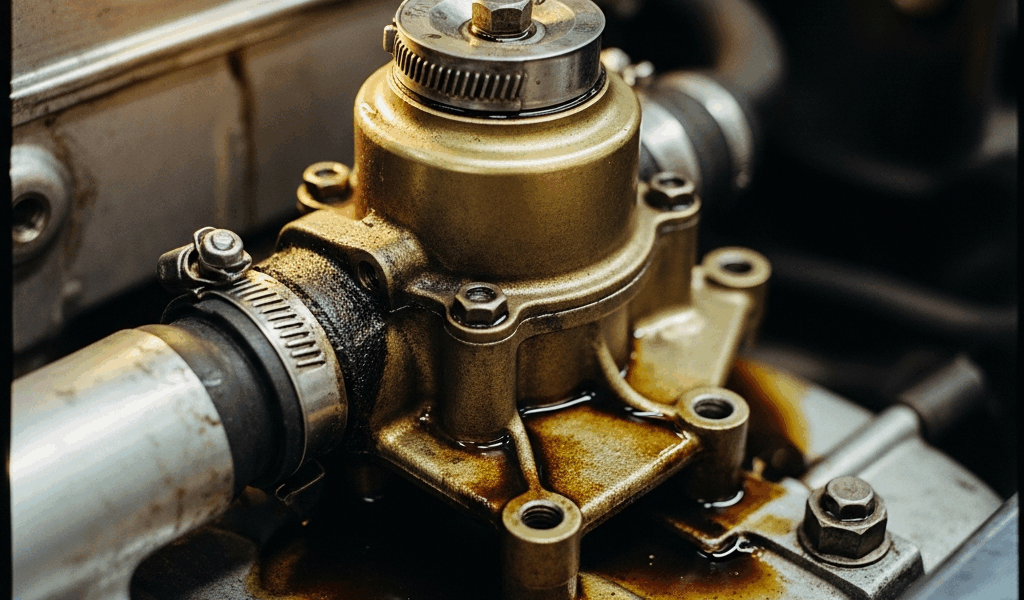
The first thing I check when a classic car arrives at my garage is the pump weep hole. That small opening at the bottom of the water pump isn’t a design flaw—it’s an early warning system.
A healthy pump weeps nothing. A failing one drips. The weep hole sits directly below the pump shaft seal, so any moisture there signals seal degradation. You’ll see it as a small puddle on the garage floor, usually bright green or orange depending on your coolant type. Some owners confuse this with transmission fluid leaks because both pool near the engine bay’s lower sections.
Here’s how to distinguish: coolant smells sweet and sticky. Transmission fluid smells mineral-sharp. Coolant stains wash away with water; transmission fluid leaves a slick residue. Inspect your specific vehicle’s layout — the water pump sits at the front center of most classic engines. If the leak originates from the pump’s housing bolts rather than the weep hole, you might get away with retightening. If it’s from the shaft seal itself, the pump is dying.
The pump may also leak at the inlet gasket where it bolts to the engine block. This leak appears as a slow seep down the front of the block, often catching engine oil and creating a brown sludge. Probably should have opened with this section, honestly — most owners miss it because they’re looking for puddles, not seeps.
Early Warning Sign 2 — Overheating That Comes and Goes
Intermittent overheating is the water pump’s calling card. The temperature gauge climbs slowly, sits at normal for 20 minutes, then spikes for no reason. A stuck thermostat stays stuck. This doesn’t.
What you’re experiencing is weak circulation. The pump impeller wears, corrodes, or cavitates—technical term for when low pressure creates vapor bubbles in the coolant. These bubbles restrict flow. On idle, restricted flow is barely noticeable. At 2,500 RPM on the highway, the engine suddenly demands cooling capacity the pump can’t deliver.
Your temperature gauge behavior will be diagnostic. If the needle climbs steadily and peaks at 210°F, stays there, then drops slightly as you slow down, the thermostat is likely stuck. If the needle bounces — normal at 180°F, then 200°F, then 190°F, then 210°F — the pump isn’t circulating steadily. I’ve seen this pattern reversed in cars where the thermostat opens too slowly, but the random variance points to the pump.
Weak circulation also causes hot spots in the block. The upper radiator hose stays hot while the lower hose stays cool. Grab both — carefully — with gloved hands while the engine runs at idle. They should feel similarly warm. If the lower hose is significantly cooler, circulation is compromised.
Early Warning Sign 3 — Grinding or Squealing From the Engine Bay
Bearing wear produces sound. The water pump shaft spins on sealed ball or roller bearings that are sealed differently than modern pumps. When those seals fail, water contamination causes rust, and rust causes noise.
A squealing sound — high-pitched, consistent — often comes from a loose belt. But if tightening the serpentine or V-belt doesn’t stop it, listen more carefully. Position yourself near the front of the engine. The squeal should be directional. Pump squeal comes from the lower-front area, around the crankshaft pulley area.
Grinding is more serious. It’s coarser, more mechanical — like rubbing metal on concrete. This indicates bearing failure. The shaft is wobbling slightly, causing the impeller to contact the pump housing. Once grinding starts, failure happens quickly. I’ve seen it progress from first detection to complete pump seizure in fewer than 500 miles.
Record the sound on your phone. Seriously. Describe it to a mechanic during diagnosis. Some people confuse alternator whine with pump noise. Alternators sing higher, from the side of the engine. Water pumps grunt and creak lower, from the front.
How to Diagnose Before You Pay for Replacement
Most owners can perform three basic checks using tools they already own or can borrow.
First—coolant inspection. Turn off the engine and let it cool for 30 minutes. Open the coolant overflow tank or radiator cap. The fluid should be opaque and colored — green or orange depending on type. If it’s rust-brown, cloudy, or contains white particles, the pump seal is compromised and allowing coolant to mix with rust. This doesn’t always mean immediate failure, but it means the system is beginning to break down. Cost to check: nothing.
Second—pressure test. You can buy a cooling system pressure tester at Harbor Freight for $35–50. This tool pressurizes your coolant system to maximum rated pressure, usually 16 PSI for classics. If pressure holds for 15 minutes, the seal is intact. If pressure drops rapidly, a leak exists. Where it leaks tells you everything: weep hole means pump seal failure; radiator hose means hose failure; block means internal corrosion. The pump-specific failure shows as weeping from the weep hole specifically during pressurization.
Third—visual inspection. Get under the front of the car with a flashlight. Look at the pump body for visible rust, pitting, or crystalline white deposits. Check the weep hole for dried coolant residue. Feel the pump housing — it should be warm but not scorching hot while the engine idles. A pump running hotter than nearby aluminum components is struggling.
When to stop and call a professional: if your pressure test shows coolant inside the crankcase, if the pump shaft moves laterally when you try to wiggle the pulley, or if you hear grinding. These indicate advanced failure requiring immediate attention and potential damage to other engine components.
What Happens If You Ignore These Signs
Best case: the pump fails completely, you overheat, and you’re stranded. You’ll need a tow and a replacement pump, likely $400–800 in labor if a shop does it.
Worse case: coolant loss becomes rapid. The engine temperature climbs beyond the thermostat’s capacity. The cylinder head warps. Internal seals fail. You’ve just upgraded from a $600 water pump replacement to a $3,000 head resurfacing or replacement. I’ve seen this happen to a friend’s 1968 Mustang when he ignored a weeping pump for six months.
Worst case: complete seizure. The pump locks, the serpentine belt snaps, and the engine keeps spinning until the timing chain breaks or the crank damages the block. Now you’re looking at engine replacement — $5,000–15,000 for a classic car, depending on rarity.
I learned to act on early signs. The cost of a $600 replacement is trivial compared to the hassle and expense of recovery. Ignoring these warning signs isn’t saving money. It’s borrowing trouble.


Stay in the loop
Get the latest classic car craze updates delivered to your inbox.