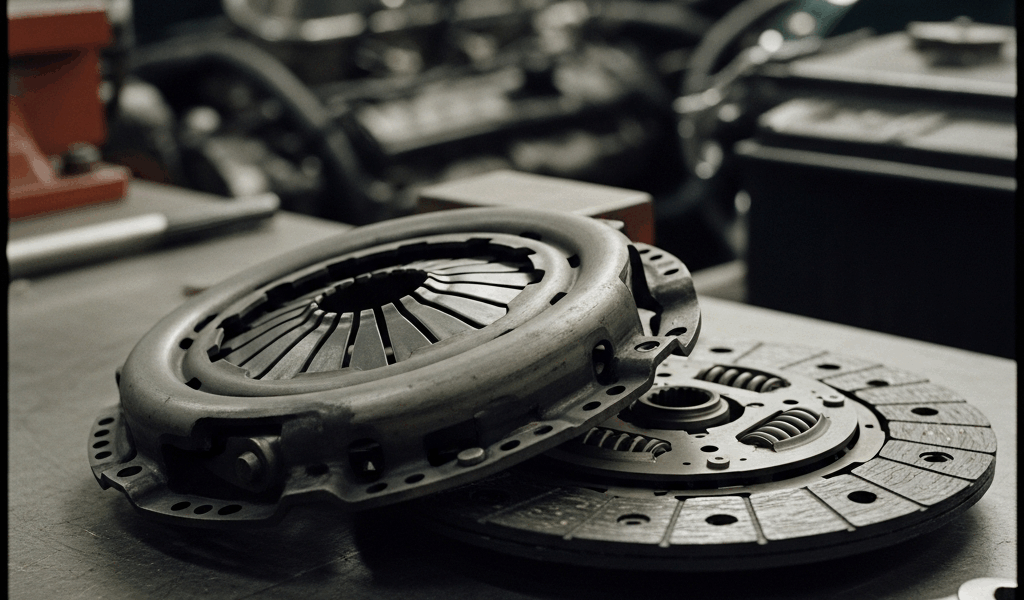
How to Tell If Your Clutch Is Actually Slipping
Classic car clutch diagnosis has gotten complicated with all the misinformation flying around. As someone who spent an entire summer chasing a ghost problem in a ’67 Mustang — convinced the 289 was dying when the transmission wasn’t even the culprit — I learned everything there is to know about clutch slip the hard way. Today, I will share it all with you.
The clearest sign? Engine RPM climbing while your speed stays flat. You’re pushing hard, the tach swings past 4,000 RPM, maybe kissing 5,000, and the car just… doesn’t respond. It’s like screaming into a void. That disconnect between what the engine demands and what the wheels actually deliver — that’s clutch slip. Full stop.
A burning smell after hard acceleration is equally telling. Acrid. Sharp. Almost like hot brakes but with a nastier edge to it. Cold starts and the occasional rough shift? Normal wear behavior. But if you’re catching that smell consistently after pushing the throttle, your disc is either glazed or worn down to nothing useful.
Then there’s the engagement point creeping toward the top of the pedal. Your clutch used to grab around the halfway mark. Now it’s grabbing near your knee. The friction disc has thinned out — the pressure plate has to travel further through its stroke just to make contact. That’s what makes gradual clutch wear so sneaky to us classic car owners. It happens slow enough that you almost don’t notice until it’s bad.
But what is clutch slip, really? In essence, it’s the friction disc failing to transfer engine power cleanly to the transmission input shaft. But it’s much more than that — it’s also easy to confuse with two completely different problems. A dragging clutch won’t fully disengage, so you get grinding during gear changes. A worn pilot bearing creates vibration and noise but doesn’t kill power transfer. A bad throwout bearing makes a racket. A slipping clutch steals acceleration quietly. Different animals entirely. Don’t mix them up.
Check the Adjustment Before Anything Else
Probably should have opened with this section, honestly. Most classic car owners have no idea their clutch is adjustable. Modern cars can’t be touched. Yours almost certainly can.
Cable-operated clutches — standard equipment on British sports cars, early Porsches, and most American classics built before roughly 1975 — need what’s called free play. That’s the slack in the cable before the throwout bearing actually contacts the pressure plate fingers. Factory spec on most of these cars lands between 1 and 1.5 inches of pedal movement before you feel resistance. Simple concept, frequently ignored.
Here’s how to measure it. Sit in the driver’s seat, engine off. Press the clutch pedal down with one finger — not your full leg, just a finger. Feel where resistance begins. Measure from the top of the pedal travel down to that resistance point. Under an inch? Your cable needs attention.
Get under the car near the bellhousing. The clutch cable runs to an adjuster on the transmission or clutch housing — usually a bolt-and-locknut setup, nothing exotic. Loosen the locknut. Turn the adjuster counterclockwise to add free play. Tighten the locknut back down. Make small moves — a quarter turn produces a noticeable difference at the pedal. I’m apparently heavy-handed with adjusters and a half-turn approach works for me while smaller increments never feel like enough, but fight that instinct. Don’t make my mistake.
A corroded cable or a worn return spring can fake clutch slip convincingly. The cable doesn’t return the pedal fully, the pressure plate never fully engages, and you get climbing RPMs without any actual disc wear. A $30 return spring from Eckler’s or a fresh cable from Dorman — probably around $45 to $65 depending on application — beats a $2,000 clutch job by a considerable margin.
Hydraulic systems — found on Jaguar E-Types, mid-1960s-onward Corvettes, and a good chunk of European classics — work differently. A master cylinder lives at the pedal, a slave cylinder sits at the bellhousing. Failing master cylinder piston seals mean the system can’t build pressure. Soft pedal, incomplete release, symptoms that look exactly like slip but aren’t.
Bleed the system first. Get a helper. Open the slave cylinder bleeder valve, have them pump the pedal three times, close the valve before they release on the third pump. Repeat until no air bubbles appear in the fluid. Air in the line produces a spongy pedal and incomplete engagement — a Saturday afternoon fix, not a transmission pull.
Bleeding doesn’t solve it? The master or slave cylinder needs a rebuild kit — roughly $15 to $40 at NAPA or online — or a full replacement, which runs $80 to $200. Still dramatically cheaper than clutch work.
Common Reasons Classic Car Clutches Slip
So, without further ado, let’s dive in — once adjustment and hydraulic issues are off the table, you’re dealing with the clutch itself.
Worn friction disc tops the list. Friction material bonds to both sides of the disc, similar to brake pad compound. Thirty or forty years of use grinds it down. Eventually the rivets contact the flywheel directly. Metal on metal. No grip, no fix — just replacement. A quality disc from Centerforce runs around $120 to $180 for most American V8 applications.
Oil contamination is a close second. Leaking rear main seals — extremely common on older American V8s, particularly pre-emissions-era big blocks — drip oil directly onto the pressure plate and disc. I learned this lesson on a 1973 Chevelle with a 454. Replaced the clutch, skipped the main seal, and 3,000 miles later the replacement disc was glazed black and soaked. The seal has to be fixed first or the new clutch fails at the same rate.
Wrong friction material catches more classic owners off guard than almost anything else. Original friction coefficients were engineered around specific engine outputs and vehicle weights. Swap in a modern Exedy or Sachs disc designed for a boosted application and it may slip on a stock 4.2-liter straight-six running 145 horsepower. Period-correct suppliers — Centerforce, RAM Clutches, Luk — produce reproduction materials matched to original specs for most popular classics.
Heat-glazed pressure plates develop a hard, shiny surface from repeated overheating. Friction material has nothing to grip against. This happens after prolonged slipping under load — towing a trailer, repeated standing starts, aggressive downshifting on canyon roads. A machine shop can sometimes surface a glazed plate for $50 to $80. Replacement is safer.
Weak diaphragm springs — found on three-finger and six-finger pressure plates common to 1960s and 1970s Porsches and several British cars — lose clamping force gradually and silently. You feel nothing changing until the clutch simply stops holding. Resurfacing won’t restore spring tension. The plate has to go.
What a Clutch Replacement Actually Involves on a Classic
Frustrated by vague shop estimates and unclear DIY guides, I mapped out exactly what this job requires using the most common classic configurations. The work itself isn’t complex — it’s just time-consuming and physical.
On a front-engine, rear-wheel-drive American classic: drop the transmission crossmember, unbolt the driveshaft from the rear differential flange, support the transmission with a floor jack, unbolt it from the bellhousing, and slide it straight back off the input shaft. Takes about two hours if nothing is seized. The clutch assembly is now fully exposed — unbolt the pressure plate in a star pattern, six bolts on most applications, and the worn disc slides right off.
This new access opens up an important side task. Pull the flywheel and take it to a machine shop for resurfacing. Don’t skip this. A worn or warped flywheel glazes a new disc in 500 miles. Budget $60 to $120 depending on how much material needs to come off — a typical resurface on a 289 or 350 flywheel runs about $75 at most independent machine shops.
On reinstall, use a clutch alignment tool. It’s a tapered plastic or aluminum shaft — Summit Racing sells a universal unit for about $18 — that slides through the new disc and centers it on the pilot bearing before you torque the pressure plate. Without it, the input shaft won’t clear the disc when the transmission slides back on. A bent or jammed input shaft means a $1,500 mistake over an $18 tool. The math is straightforward.
Rear-engine cars are a different world entirely. Frustrated by how rarely this gets acknowledged, I’ll say it plainly: a 1973 Porsche 911 clutch job means pulling the engine. The transmission lives forward of the engine, which lives behind the rear axle. Budget a full day minimum and have an engine support bar on hand — Harbor Freight’s adjustable version runs about $65 and earns its keep here. British Minis and early front-wheel-drive European cars have their own particular quirks. Sometimes the subframe drops, sometimes the engine tilts forward on mounts, sometimes it’s genuinely model-year specific. Research your exact car before assuming.
That’s what makes classic car ownership endearing to us enthusiasts — every car has its own personality, including the annoying parts. A front-engine American or straightforward European sports car is a solid weekend DIY job. A rear-engine or tight-quarters build is when a good independent shop saves your sanity.
Cost to Replace a Classic Car Clutch
Parts for a quality reproduction clutch kit — pressure plate, disc, throwout bearing, alignment tool — run $300 to $600 for most American V8 classics. A Mustang 289 kit from McLeod or Centerforce lands around $340 to $420. British sports cars and European models push slightly higher, $400 to $700, because production volumes are smaller and fewer suppliers bother.
Flywheel resurfacing adds $60 to $120. A quality throwout bearing — I’m apparently prone to skipping this and a Timken or Sachs unit works for me while the generic house-brand versions never last — runs $40 to $80. Budget both. They wear together.
Labor at an independent shop: $1,200 to $2,000 for a standard American car, $1,500 to $2,500 for complex imports. A Porsche 911 clutch job at a marque specialist — someone like Sunset Motorsports or a certified independent — runs $3,000 to $4,000 because engine removal adds four to six hours of labor alone.
Total out-of-pocket on a quality DIY job with new parts: $1,800 to $2,500 roughly. Shop work on something straightforward: $2,500 to $3,500. Complex rear-engine or specialty builds: $4,000 to $4,500 isn’t unusual. Skipping the flywheel resurface saves maybe $80. It guarantees a callback job in under a year. Don’t do it.
Start with the cable adjustment or hydraulic bleed — a $0 to $50 investment that resolves the problem in roughly half the cases I’ve encountered. Once you’ve genuinely confirmed disc wear and addressed any oil leaks at the source, a full clutch replacement is money spent well. The car will feel like itself again. More importantly, you’ll know exactly what you fixed and why it held.


Stay in the loop
Get the latest classic car craze updates delivered to your inbox.